

 Smartwatch
 Smart Ring
 Smart Band
 Batteries
 Ups
Ups Power Bank
 TWS
TWS Bluetooth Speaker
 Headphones
 Neckband
 Microphones
 Tripods
 Studio Light
 Tracking Device
 Portable Fan
 Power Adapters
 Portable Speaker
 Rechargeable Fan
 Smart Lights
 Smart Clock
 WiFi Routers
 Kitchen Gadgets
 Air Cooler
 Acrylic Night Lamps
 Display Gadgets
 Neon Lights
 Ambient Lighting
 Camping Fan
 Camping Gear
 Camping Light
 Survival Gadgets
 RC Boat
 RC Car
 RC Planes & Drones
Solar panel + power bank setup for Bangladeshi homes – is it worth it?

Our Verdict — Before You Read Anything Else
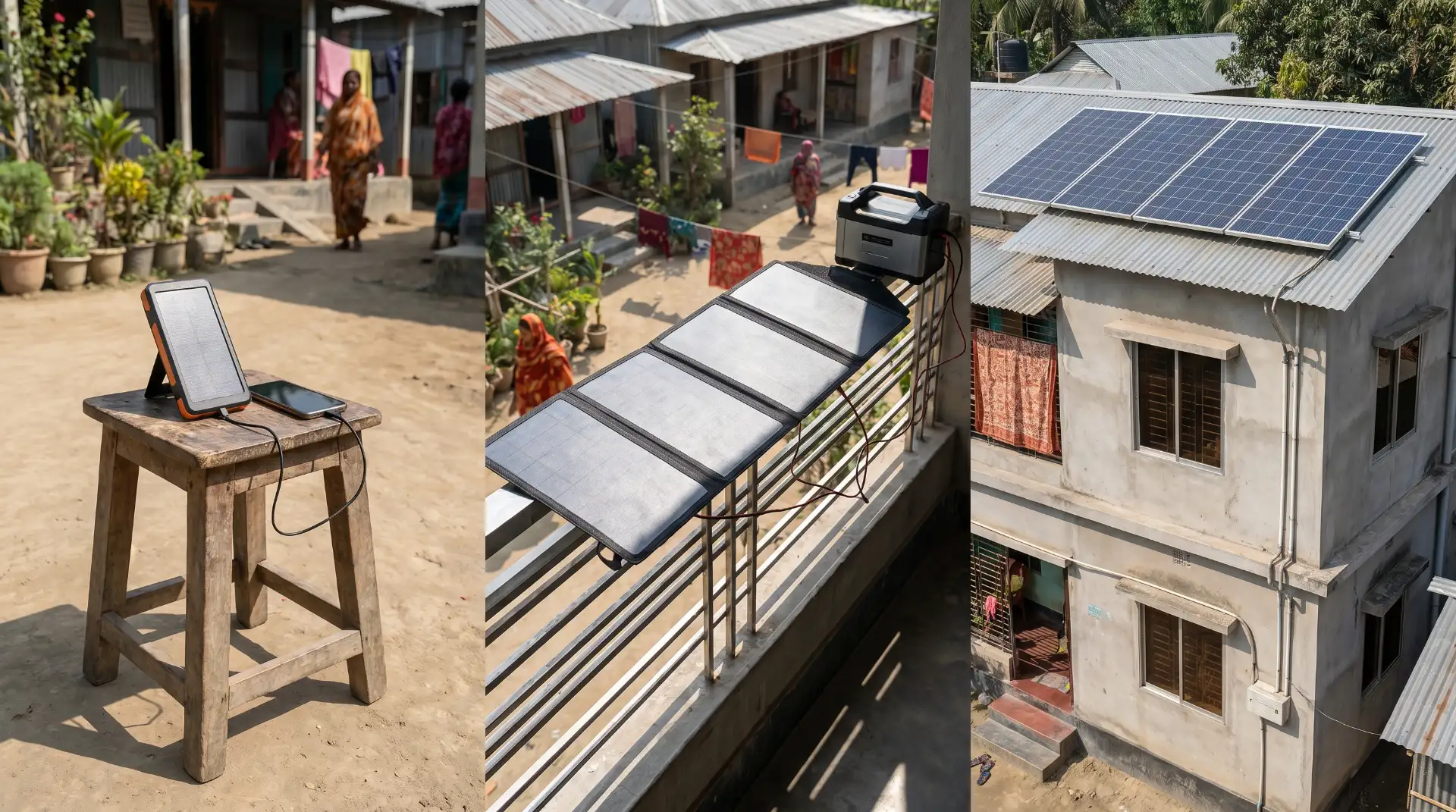
For most Bangladeshi households: yes, a solar setup is worth it – but only if you pick the right type. A “solar power bank” (built-in panel) from a Facebook page is mostly a gimmick. A dedicated portable solar panel paired with a quality power bank is genuinely useful during Dhaka summers and for rural households. A rooftop solar home system offers the best long-term value but needs ৳80,000–৳1,50,000 to start. This guide tells you exactly which option suits your situation.
Bangladesh gets an average of 4–5 kWh of solar radiation per square meter every single day. That is more than Germany, Japan, and most of Europe – countries that have built massive solar industries. The sun is not the problem here.
The problem is that most Bangladeshis look at solar panels and see a high upfront cost, confusing product categories, and the monsoon season. So the question “Is solar worth it?” never gets a straight answer.
This guide gives you that straight answer. We break solar into three real options available in Bangladesh today – with actual prices, honest runtime numbers, and a clear verdict for each type of household. It is Part 5 of our complete load-shedding survival guide for Bangladesh.
What This Guide Covers
- How much sun does Bangladesh actually get? (The real numbers)
- The 3 types of solar setups you can buy in Bangladesh – and how they differ
- Solar power banks with built-in panels – honest truth
- Dedicated solar panel + power bank combo – how it works and what it costs
- Rooftop solar home system – for serious backup
- The Bangladesh monsoon problem – what happens to solar in June-September
- Side-by-side cost and performance comparison
- Who should buy what – quick decision guide
- Common mistakes Bangladeshis make with solar
- FAQ
1. How Much Sun Does Bangladesh Actually Get?
Before deciding if solar is worth it, you need to know your raw material – sunlight. Bangladesh is positioned between 20°N and 26°N latitude, which places it squarely in the tropical zone. The numbers from research institutions are clear:
4-5
kWh/m² solar radiation per day (annual average)
5-6.5
kWh/m² peak in March–May (best solar months)
3-4
kWh/m² during monsoon (June–September)
4.5-5
Peak sun hours per day (usable for solar panels)
To put this in context: a 100W solar panel in Bangladesh gets roughly 4.5-5 peak sun hours per day on average. That means it can generate 450-500 watt-hours (Wh) of electricity daily during the dry season – enough to fully charge a 20,000mAh power bank (74Wh) about 6 times over.
| Season / Months | Avg. Peak Sun Hours/Day | 100W Panel Output/Day | Solar Verdict |
|---|---|---|---|
| Dry season (Nov–Feb) | 5.5–6.5 hrs | ~480–580 Wh | Excellent – peak solar performance |
| Hot season (Mar–May) | 5.0–6.0 hrs | ~430–540 Wh | Very good – also peak load-shedding season |
| Early monsoon (Jun–Jul) | 3.5–4.5 hrs | ~300–400 Wh | Reduced – panels still work, but output drops |
| Peak monsoon (Aug–Sep) | 2.5–3.5 hrs | ~200–300 Wh | Limited – rely on grid charging as primary |
| Early dry (Oct–Nov) | 4.5–5.5 hrs | ~380–490 Wh | Good – recovery month, solar returns |
Key Takeaway
Bangladesh gets 8-9 genuinely good solar months per year (October through May). The peak load-shedding months (March-May) almost perfectly overlap with peak solar months. This is actually ideal – solar is most useful exactly when the power crisis is worst.
2. The 3 Types of Solar Setups in Bangladesh
Most of the confusion around solar comes from treating these three very different products as if they are the same thing. They are not. Here is how they differ at a glance:
| Type | Price Range (BD) | What it charges | Solar input | Best for |
|---|---|---|---|---|
| Solar power bank (built-in panel) | ৳1,600–৳3,500 | Phone only | 0.5-2W (slow) | Emergency trickle backup |
| Dedicated panel + power bank combo | ৳8,000–৳20,000 | Phones, fans, lights | 20-100W (practical) | Most urban/suburban homes |
| Rooftop solar home system | ৳80,000–৳3,00,000+ | Full home appliances | 500W-5kW+ | Rural homes, serious backup |
3. Solar Power Banks with Built-In Panels – The Honest Truth
These are the products sold on Daraz and Facebook pages – a power bank with a small solar strip on the back. They cost ৳1,600-৳3,500 and claim “20,000mAh with solar charging.”
Here is the honest truth about the solar part of these products:
Skip if:
- You mainly need backup during the Dhaka load-shedding
- You want reliable daily solar charging
- You have a balcony or rooftop with open sun access
Consider if:
- You travel or camp frequently in remote areas
- You want emergency solar backup as a last resort
- Budget under ৳3,000 and only one phone to charge
4. Dedicated Solar Panel + Power Bank Combo – The Practical Sweet Spot
This is the setup that most Bangladeshi homes should consider. A separate foldable 20-100W solar panel paired with a quality 20,000-30,000mAh power bank (or a portable power station). They connect via a DC or USB-C cable.
Why this combination works better than a solar power bank: the panel is large enough to generate real power, the power bank stores it, and you can use either independently. You can also upgrade one piece without replacing the other.
How the Setup Works
☀️
Solar Panel
20–100W
placed on balcony or roof
🔋
Power Bank / Station
20,000–100,000mAh
charges via DC or USB-C
📱
Your Devices
Phones, fan, lights, router
The panel charges the bank during the daytime. You can use the bank any time – day or night, grid on or off.
Runtime Calculator – What Can You Power?
Using Bangladesh’s average of 4.5 peak sun hours/day, here is what different panel sizes can generate and what that powers:
| Panel Size | Energy / Day (4.5 hrs) | Phone charges/day (5,000mAh @ 65% efficiency) | Rechargeable fan runtime/day | BD Panel Price Est. |
|---|---|---|---|---|
| 20W portable panel | ~80 Wh | ~2 full charges | ~5 hrs (8W fan) | ৳6,500-৳10,000 |
| 40W portable panel | ~160 Wh | ~4 full charges | ~10 hrs (8W fan) | ৳11,000-৳18,000 |
| 100W fixed panel | ~400 Wh | ~9–10 charges | ~25 hrs (8W fan) | ৳8,000-৳14,000 |
| 200W fixed panel | ~800 Wh | ~18–20 charges | ~50+ hrs (8W fan) | ৳16,000-৳28,000 |
Output figures use 75% panel efficiency under real-world Bangladesh conditions. Fixed panel prices are for StarTech BD pricing as of April 2026 (৳20–৳40/watt). Portable folding panel prices vary by brand and quality.
Recommended Kit for a Typical Dhaka Household
Panel
100W Monocrystalline Panel
Longi, Trina, or Canadian Solar – available at StarTech
৳8,000-৳14,000
Storage
Baseus 20,000mAh 65W or Portable Power Station
Must support solar/DC input – check before buying
৳3,000-৳12,000
Extras
DC cable + charge controller (if panel is 40W+)
MPPT controller recommended for best efficiency
৳1,000-৳3,000
Total estimated cost: ৳12,000–৳29,000 depending on storage choice. This setup keeps 3–4 phones charged, runs a rechargeable fan for 6–10 hours, and keeps a WiFi router alive — all from the sun, daily.
5. Rooftop Solar Home System – For Serious Backup
A rooftop solar home system (SHS) is a full installation – multiple panels on your roof, a charge controller, battery bank, and an inverter to produce 220V AC power for your home. This is what over 3.5 million Bangladeshi homes already use through IDCOL’s solar home system program.
| System Size | Daily Output | What It Powers | Est. Install Cost (BD) | Payback Period |
|---|---|---|---|---|
| 500W (basic home) | ~2.0 kWh/day | Lights, fans, phone charging, router | ৳80,000–৳1,20,000 | 4–6 years |
| 1kW (medium home) | ~4.0 kWh/day | All above + TV, small fridge | ৳1,20,000–৳1,80,000 | 5–7 years |
| 2kW (large home/office) | ~8.0 kWh/day | All above + AC, washing machine | ৳2,50,000–৳3,50,000 | 6–9 years |
Is the Payback Period Worth It?
A good quality solar panel system lasts 20-25 years. After the payback period (5–7 years), you essentially get free electricity for the next 15-20 years. With Bangladesh electricity prices rising 14 times in the last decade, locking in solar generation now is a strong financial decision for homeowners.
Best candidates: households with a flat rooftop, located in rural areas with 6+ hours of daily outages, or families spending ৳2,000–৳5,000+ per month on electricity bills.
6. The Bangladesh Monsoon Problem – Honest Answer
The most common objection to solar in Bangladesh: “What about the monsoon? 4 months of rain will kill the whole investment.”
This concern is real but often overstated. Here is the actual picture:
Facts about solar + monsoon
- Panels work on diffuse light – even heavy clouds generate 20-40% of rated output
- Rain actually cleans your panels, removing dust that reduces efficiency during dry months
- Bangladesh monsoon is June–September – only 4 months, not 6 months as many assume
- Even in peak monsoon, a 100W panel generates 200–300Wh/day – enough for phone charging and fan backup
- Load-shedding is actually less severe during monsoon months because demand for cooling drops
Real limitations to plan for
- Solar output drops 50–65% during heavy monsoon rain periods
- Grid charging remains your primary backup source, June–September
- A larger battery bank helps store energy from good monsoon days to cover bad ones
- Portable panels need protection from rain – place under an overhang with an open sky view
- Rooftop panels are weatherproof – monsoon is not an issue for permanent installations
Bottom Line on Monsoon
Design your solar setup around the 8 good months, not the 4 difficult ones. During monsoon, treat solar as a supplement to grid charging – not a replacement. The economics still work strongly in your favour across the full year.
7. Full Comparison – All 3 Options Side by Side
| Factor | Solar PB (built-in panel) | Panel + Power Bank (combo) | Rooftop Solar (full SHS) |
|---|---|---|---|
| Cost to start | ৳1,600-৳3,500 | ৳12,000-৳29,000 | ৳80,000-৳3,00,000+ |
| Solar charging speed | Very slow (0.5-1.5W) | Practical (20–100W) | Full home (500W-5kW) |
| Portability | High – pocket-sized | Medium — foldable panel | Fixed installation |
| Monsoon performance | Worse (panel too small) | Reduced but usable | Reduced but reliable |
| Long-term ROI | Poor | Good (3–5 yr payback) | Excellent (5-9 yr payback, 20yr life) |
| Installation needed | None – plug and play | Minimal (cable + panel placement) | Professional install required |
| Charges fan + router? | No | Yes (with the right setup) | Yes – and much more |
| Best for whom | Campers, travelers | Most BD households | Rural homes, homeowners |
8. Quick Decision Guide – Who Should Buy What
9. Common Mistakes Bangladeshis Make with Solar
This Article Is Part of a Series
Solar tackles the grid problem from the supply side. But you also need the right gadgets to store and use that energy -rechargeable fans, a mini UPS for your router, and the right power bank. Our complete load-shedding survival guide for Bangladesh covers all of that together in one place.
Before pairing a solar panel with a power bank, make sure you understand real mAh capacity – our mAh loss guide explains exactly how much charge you will actually get and how to pick the right power bank for your solar setup.
Frequently Asked Questions
Power Backup Products – Tested for Bangladesh Conditions
Shop Power Banks, Fans and Backup Gadgets at Gadgeterians
While you plan your solar setup, make sure your immediate backup is sorted. Every power bank and rechargeable fan at Gadgeterians is tested before listing – genuine capacity, real warranty, fast delivery across Bangladesh.
Written by
Gadgeterians Team
The Gadgeterians Team is a group of gadget enthusiasts, tech writers, and product testers based in Dhaka, Bangladesh. We research, test, and write about power backup solutions specifically for Bangladeshi households – from the real output of power banks during load-shedding, to how solar panels perform through the monsoon season. Our mission is to give people here the most honest, practical gadget advice available – without the fluff or the copy-paste specs.
Power Backup
Bangladesh Gadgets
Load-Shedding Solutions
Product Testing
More from this series