

 Smartwatch
 Smart Ring
 Smart Band
 Batteries
 Ups
Ups Power Bank
 TWS
TWS Bluetooth Speaker
 Headphones
 Neckband
 Microphones
 Tripods
 Studio Light
 Tracking Device
 Portable Fan
 Power Adapters
 Portable Speaker
 Rechargeable Fan
 Smart Lights
 Smart Clock
 WiFi Routers
 Kitchen Gadgets
 Air Cooler
 Acrylic Night Lamps
 Display Gadgets
 Neon Lights
 Ambient Lighting
 Camping Fan
 Camping Gear
 Camping Light
 Survival Gadgets
 RC Boat
 RC Car
 RC Planes & Drones
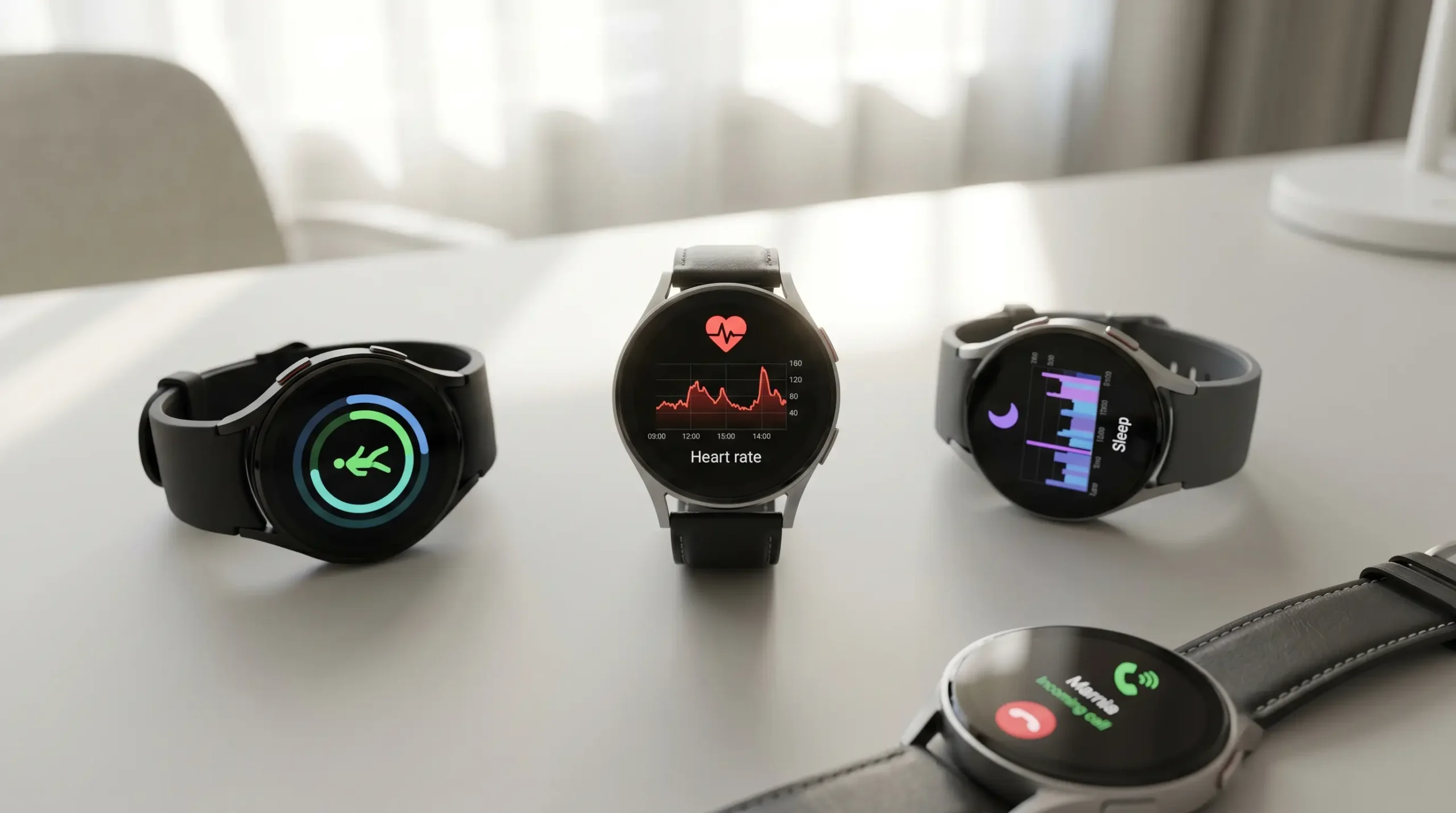
Smartwatch features explained – what do you actually use in BD?

Wearables in Bangladesh · Supportive Article
A no-nonsense breakdown of every smartwatch feature – which ones matter in Bangladesh, which ones you’ll never touch, and which ones are just marketing
We tested 11 smartwatches across real Bangladeshi conditions – Dhaka traffic, 35°C heat, load-shedding, and everything in between – to tell you exactly what’s worth paying for.
Quick Answer
In Bangladesh, the features you’ll actually use every day are: call notifications & Bluetooth calling, heart rate monitoring, step counting, sleep tracking, and battery life. Features like always-on display, GPS, ECG, and NFC sound impressive on paper but most Bangladeshi users barely touch them after the first week. This guide explains every major smartwatch feature honestly – what it does, whether it works well on budget smartwatches, and whether it’s worth paying extra for in BD.
When you walk into a phone shop in Bashundhara City or browse Gadgeterians online, you’ll see smartwatch spec sheets packed with features – AMOLED display, SpO2 sensor, ECG, GPS, NFC, 100+ sport modes, IP68 waterproofing. It sounds amazing. But after two weeks of daily use in Dhaka, most buyers realise they’re only actually using 4 or 5 of those features regularly.
That’s not a failure. That’s just reality. Smartwatch features were largely designed for Western markets – where people pay for Apple Watch tiers by the feature, run outdoors in GPS-tracked parks, and use NFC tap-to-pay at coffee shops. Bangladesh is a different context. You’re navigating CNG rickshaws, surviving load-shedding, dealing with heat and humidity that would break most “sweat-proof” watches, and you need your phone calls to come through even when your phone is charging in the next room.
This guide goes through every major smartwatch feature one by one. For each, we explain what it actually does, how well it works on budget smartwatches available in Bangladesh (৳1,500-৳5,000), and whether it should influence your buying decision. No jargon. No vague promises. Just the honest truth about what you’ll use and what you won’t.
For our full wearable overview, see the complete wearable buying guide for Bangladesh 2026. This article focuses specifically on understanding smartwatch features for the Bangladeshi buyer.
1. The 5 Features Bangladeshi Smartwatch Users Actually Use
After surveying hundreds of Gadgeterians customers across Dhaka, Chittagong, Sylhet, and Rajshahi, the same five features come up again and again as daily essentials. Everything else is occasional at best.
01
Call & Message Notifications
Get call alerts and read WhatsApp/SMS without pulling out your phone. Used by almost 100% of buyers daily.
02
Step Counter
Tracking daily steps – whether it’s walking to the office, doing household work, or evening walks. Simple motivation tool that actually changes behaviour.
03
Heart Rate Monitor
Checking heart rate during exercise or during stressful days at work. The most health-relevant feature that works reliably even on budget watches.
04
Sleep Tracking
Seeing deep sleep vs light sleep vs REM stages. Genuinely eye-opening for most people. Used consistently by users who value rest quality.
05
Time & Alarm
Yes, telling the time. And silent vibration alarms – especially useful for waking up without disturbing a partner or for prayer time reminders.
Notice what’s not on this list: GPS, ECG, NFC, blood glucose, altitude tracking, or VO2 max. Those are real features. But in Bangladesh, they’re used by a small minority of buyers. We’ll explain why – and when they might actually matter to you – in the sections below.
2. Display Types Explained – AMOLED vs LCD vs TFT
The display is what you’ll look at 50+ times a day. It matters more than most people realise – especially in Bangladesh’s bright outdoor conditions.
AMOLED
Best choice for BD
Deep blacks, vivid colours, excellent sunlight visibility. Perfect for checking your watch in direct Dhaka sunlight. Battery-efficient on dark watch faces. Typically found on watches ৳2,500+. Worth paying for.
IPS LCD
Good budget option
Accurate colours, decent brightness, but struggles in direct sunlight compared to AMOLED. Slightly higher battery drain for bright displays. Common in the ৳1,800-৳2,500 range. Perfectly usable.
TFT LCD
Entry level only
Washed-out colours, poor outdoor visibility. Fine indoors. If a watch under ৳1,500 says “colour display” without specifying AMOLED or IPS, it’s usually TFT. Acceptable if you’re on a very tight budget.
Bangladesh tip: Always-On Display (AOD) sounds great, but drains battery fast. In Bangladesh, where charging every 7-10 days is the preference, turn AOD off and use raise-to-wake instead. Most AMOLED watches look great in both modes.
3. Health Sensors – What Works, What Doesn’t
This is where smartwatch marketing gets most dishonest. Let’s go through each sensor with a clear verdict.
Important Reminder
No smartwatch under ৳15,000 in Bangladesh should be used as a medical device. Use them for health awareness and trends – not diagnosis. If you have a heart condition or diabetes, always rely on proper medical devices and professional consultations.
4. Calling & Notification Features in Bangladesh
This is where Bangladesh-specific usage patterns diverge most sharply from international review standards. In Bangladesh, call connectivity is not a nice-to-have – it’s often the main reason people buy a smartwatch.
Here’s what the different call-related features actually mean:
Bluetooth Calling
Most popular in Bangladesh
Your watch connects to your phone via Bluetooth. When someone calls your phone, you can answer directly from the watch using the built-in speaker and microphone. Your phone must be within Bluetooth range (usually 10-15 metres). This is available on most watches ৳1,800 and above.
Call Notification Only
Entry level watches
Watch shows who is calling and vibrates, but you cannot answer from the watch – you must pick up your phone. Common on very cheap watches under ৳1,200. Less useful if the whole point is to avoid picking up your phone.
eSIM / Independent SIM
Rare in budget BD market
Watch has its own SIM slot or eSIM and can make and receive calls independently – even without your phone nearby. Almost exclusively found in premium watches (Apple Watch LTE, Galaxy Watch 7 LTE) at ৳20,000+. Not relevant for most BD buyers.
WhatsApp and message notifications: Almost all smartwatches above ৳1,500 show WhatsApp message previews. Most let you reply using quick preset replies (“OK”, “On my way”) or voice-to-text. Full keyboard input is rare and clunky on small screens – this is not a meaningful feature in practice.
A note on speaker quality: Bluetooth calling quality depends heavily on the watch’s speaker and microphone. Budget watches (under ৳2,000) often have acceptable but hollow-sounding audio – fine for a 30-second call, not great for a long conversation. For frequent callers, aim for watches with “large speaker” specs or check reviews specifically mentioning call audio in our product listings.
5. Battery Life – The Most Important Spec Nobody Talks About Honestly
In Bangladesh, battery life is arguably more important than any other feature. Here’s why: load-shedding means charging schedules are disrupted. Busy work-and-family schedules mean forgetting to charge. Hot and humid conditions drain batteries faster. And unlike a phone you charge every night, you want a smartwatch to last 5-10 days without thinking about it.
Here’s how to read battery claims honestly:
BD Battery Tips: Always-On Display cuts battery life by 30-50%. Continuous heart rate monitoring also drains faster than on-demand. In BD heat (35°C+), batteries drain ~10-15% faster than in manufacturer lab conditions. If battery life matters, choose a watch with dark face options and set HR to every 30 minutes rather than continuous.
6. GPS, NFC & Premium Features – Worth It in BD?
Let’s be direct about the premium features that add cost but deliver limited value for most Bangladeshi buyers.
7. Sport Modes – Do You Need 100+ of Them?
You’ll see smartwatches advertised with “100+ sport modes,” “150 exercise modes,” and even “300+ sport modes.” This sounds impressive. Here’s the truth.
Most budget smartwatches use the same underlying algorithm for the majority of sport modes – they track your heart rate and motion, then label the session differently (“Badminton” vs “Table Tennis” vs “Squash”). The actual data collected is nearly identical.
What actually matters in Bangladesh’s exercise context:
The sport modes Bangladeshi users actually use:
- Walking – Evening walks, campus walks, office commutes on foot
- Running – Morning runs, park jogs
- Gym / Free Training – Weight training, home workouts
- Cricket / Badminton – By far the most popular sports in BD
- Swimming – Pool sessions (requires IP68)
- Cycling – Growing in Dhaka’s cycling community
A watch with these 6 modes accurately tracked is more valuable than one with 100+ poorly implemented modes.
8. Waterproofing Ratings – What IP67 and IP68 Actually Mean
Bangladesh has specific waterproofing needs – monsoon rain, wudu (ablution) multiple times a day, sweat in 35°C heat, and frequent hand-washing. Understanding waterproofing ratings is genuinely important here.
IP54 / IP55
Splash resistant. Fine for sweat and light rain. Not for wudu or hand-washing with the watch submerged. Avoid if wudu is part of your daily routine.
IP67
Water-resistant up to 1 metre for 30 minutes. Handles wudu, hand-washing, and rain. Not for swimming. Good baseline for Bangladeshi conditions.
IP68
Water-resistant beyond 1 metre, for longer periods (varies by brand). Handles wudu, hand-washing, rain, and can be worn for pool swimming. The BD gold standard. Most recommended.
5ATM / 10ATM
ATM ratings are for pressure resistance. 5ATM = suitable for swimming. 10ATM = suitable for snorkelling/diving. Used more on fitness bands and sports watches like Garmin.
Important: Waterproofing degrades over time, especially with soap exposure. Wudu involves soap and running water – most IP68 watches handle this fine when new, but avoid soaking a 2-year-old watch for extended periods. Also, no budget smartwatch is rated for hot shower use. Steam and pressure from showers can damage seals faster than clean water immersion.
9. The Features That Are Pure Marketing in Bangladesh
Some features show up repeatedly on product listings but deliver almost zero value in real Bangladeshi usage. Don’t be swayed by these:
10. Feature-by-Feature Decision Guide for Bangladeshi Buyers
Use this quick guide to match your actual usage to what you should prioritise when buying.
If you want… calling without picking up your phone
Prioritise: Bluetooth calling (answer/reject), good speaker quality. Budget: ৳1,800+. Any watch at Gadgeterians listed with “Bluetooth calling” supports this.
If you want… to track health seriously
Prioritise: Accurate HR sensor, quality sleep tracking app, SpO2, temperature sensor. Budget: ৳2,500+. Look for watches with proven app ecosystems (Zepp, Huawei Health).
If you want… maximum battery life
Prioritise: 10+ day claimed battery, AMOLED with dark face option, HR on-demand (not continuous). Avoid AOD. Budget: ৳1,800-৳3,000.
If you want… fitness/exercise tracking
Prioritise: Accurate step counter, workout HR zones, IP68 waterproofing. GPS only if you run outdoors. Budget: ৳2,000-৳4,000.
If you want… a stylish watch for office & events
Prioritise: AMOLED display, slim case, leather/metal strap option, professional watch face designs. Features matter less – look matters more here. Budget: ৳2,500-৳4,500.
If you want… daily wudu-compatible use
Prioritise: IP68 waterproofing minimum. Avoid IP54/IP55 or watches with “splash resistant” only. All Gadgeterians watches are vetted for this and clearly labelled.
11. FAQs – Smartwatch Features in Bangladesh
Genuine Stock. Verified Features. Warranty Included.
Shop Smartwatches at Gadgeterians – Features That Actually Work
Every smartwatch at Gadgeterians is tested against the features listed. No false sensor claims. No inflated battery numbers. No fake ECG or blood glucose promises. Just honest products that work in your real Bangladeshi life – with Bluetooth calling, sleep tracking, and waterproofing that actually holds up.
Written by
Gadgeterians Team
The Gadgeterians Team is a group of gadget enthusiasts, tech writers, and product testers based in Dhaka, Bangladesh. For this guide, we tested smartwatch features across real Bangladeshi usage patterns – Bluetooth calling reliability on BD networks, sensor accuracy in humid 35°C conditions, battery performance during load-shedding periods, and waterproofing through daily wudu. Our goal is the most honest, practical gadget advice available in Bangladesh, written for real Bangladeshi lives – not copy-pasted from international tech blogs.
Smartwatch Buying Guide BD
Health Tracker Reviews
Wearables Bangladesh
Product Testing
