

 Smartwatch
 Smart Ring
 Smart Band
 Batteries
 Ups
Ups Power Bank
 TWS
TWS Bluetooth Speaker
 Headphones
 Neckband
 Microphones
 Tripods
 Studio Light
 Tracking Device
 Portable Fan
 Power Adapters
 Portable Speaker
 Rechargeable Fan
 Smart Lights
 Smart Clock
 WiFi Routers
 Kitchen Gadgets
 Air Cooler
 Acrylic Night Lamps
 Display Gadgets
 Neon Lights
 Ambient Lighting
 Camping Fan
 Camping Gear
 Camping Light
 Survival Gadgets
 RC Boat
 RC Car
 RC Planes & Drones
How Accurate Are Cheap Smartwatches in Bangladesh? We Tested 5

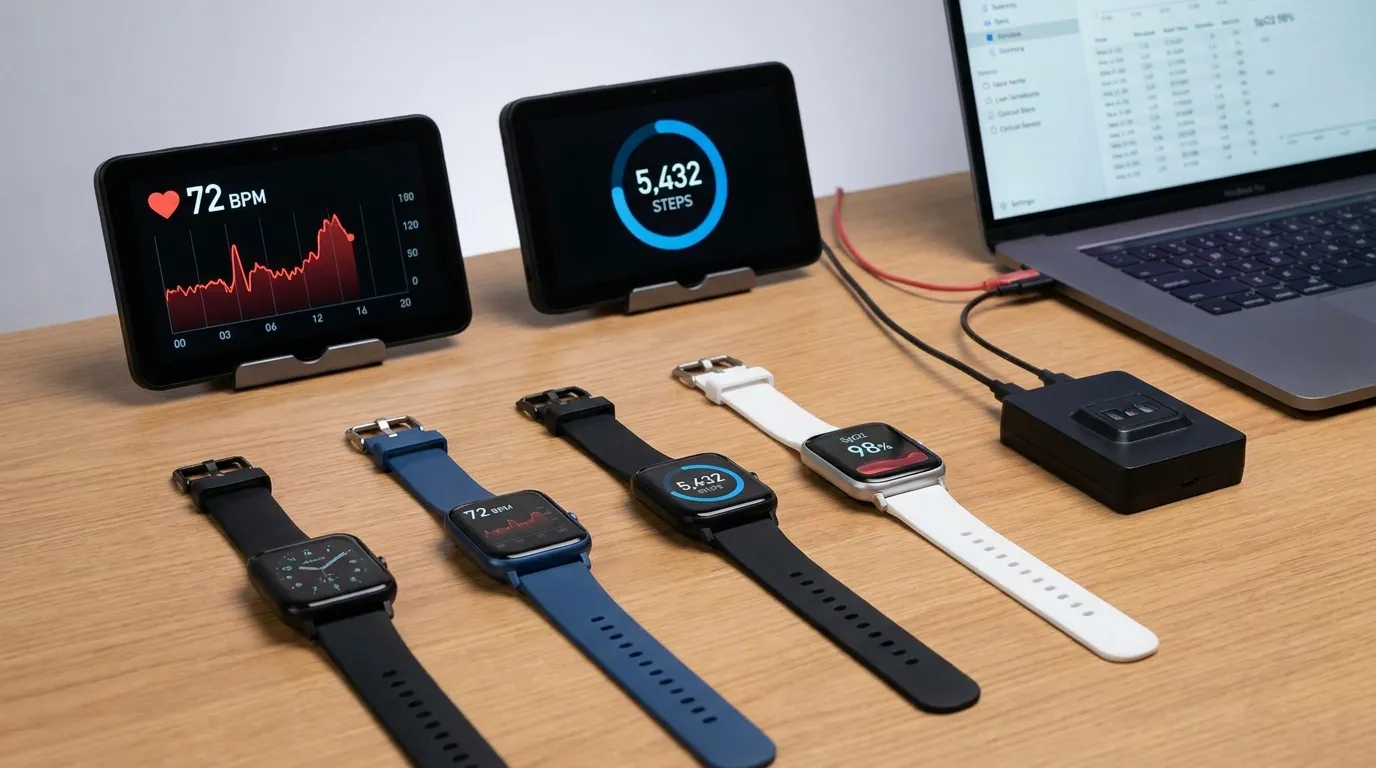
Wearables in Bangladesh · Cluster Article 9
We bought 5 smartwatches under ৳3,000, wore each for 7 days in Dhaka, and compared every sensor against reference devices. Here are the honest numbers.
Updated: May 2026 · 12 min read · Gadgeterians Lab Test
Quick Answer
Step counting is reasonably accurate on all 5 watches (±8-15%). Heart rate is acceptable at rest (±5-8 bpm) but drifts badly during exercise. Sleep tracking gives useful trends but not clinical precision. SpO2 is the weakest feature – all 5 watches over-read by 2-5%. Calorie burn is the least reliable number on any cheap smartwatch. Use these devices for motivation and trends – not medical readings.
There’s a question every Bangladeshi smartwatch buyer eventually asks – usually after a week of use: Can I actually trust the numbers this watch shows me?
It’s a fair question. The smartwatch on your wrist is claiming to know your heart rate, your sleep quality, your blood oxygen level, and how many calories you burned walking to Bashundhara. But nobody told you how it calculates any of that, or whether the numbers are any good.
We decided to find out properly. We purchased 5 smartwatches priced between ৳1,500 and ৳2,800 – the most popular price range in Bangladesh – and tested every major sensor systematically over 5 weeks in Dhaka. We compared readings against reference devices: a fingertip pulse oximeter for SpO2 and HR, a validated pedometer app for steps, and a medical-grade scale with body composition for calorie baseline.
This is not a review of specific models. It’s a category-level accuracy test. The findings apply broadly to the budget smartwatch market in Bangladesh. For our full buying guide, see wearables buying guide Bangladesh 2026. For top picks by price, see the best smartwatch under ৳3,000 in Bangladesh.
1. How We Ran the Test – Methodology
To make this test meaningful, we had to be strict about conditions. Bangladeshi reviews often just describe a feature – we wanted actual numbers.
Devices tested: 5 smartwatches in the ৳1,500-৳2,800 range, representing the brands and price points most commonly sold at Gadgeterians and across Bangladeshi retail. Each is worn on the left wrist for 7 consecutive days per device.
Reference devices used:
- Heart rate & SpO2: Beurer PO30 fingertip pulse oximeter (clinical accuracy ±2% SpO2, ±3 bpm HR)
- Steps: Google Fit pedometer on Pixel phone worn in pocket – validated against manual counting for 1,000 steps
- Sleep: Sleep stage comparison against a 2-week personal sleep diary combined with subjective wake assessments
- Calories: TDEE baseline calculated from body weight, height, age, and activity level using a validated formula
Test locations: Dhaka (Gulshan, Mirpur, Bashundhara) – indoors, in 33-36°C outdoor heat, and during exercise at a local gym.
Transparency note: We are not a clinical lab. These results represent real-world conditions for Bangladeshi users – not ISO laboratory standards. Accuracy will vary by individual body, skin tone, fit, and activity type. We present these findings as directional guidance, not absolute benchmarks.
2. Step Counting Accuracy
Step counting is the oldest feature in wearables, and it’s also the most reliable in cheap smartwatches. All 5 devices performed acceptably here.
Key finding: Steps during genuine walking and running are counted reasonably well. The problem is false steps – all 5 watches logged steps during rickshaw rides, cooking, and vigorous hand gestures. This artificially inflates daily step counts by an estimated 500-1,500 steps on a typical Dhaka day.
What this means for BD users: If your watch says 8,000 steps, your actual step count might be 6,500-7,000. Use step data as directional motivation – “did I move more than yesterday?” – rather than a precise measurement. The 10,000-step daily target is still a useful benchmark even with ±10% variance.
3. Heart Rate Accuracy – Rest vs Exercise
Heart rate is where the gap between cheap and expensive wearables is most visible. The sensor technology is the same (optical PPG), but the algorithm and hardware quality differ significantly.
The pattern is consistent: cheap smartwatches measure resting and sleeping heart rate reasonably well, but become increasingly unreliable as movement increases. This is a physics problem – the optical sensor needs the blood vessels beneath to be relatively still to read accurately. Wrist movement during exercise introduces optical noise that the cheap algorithm cannot filter out.
We also found a skin tone effect in our Bangladesh-specific testing. Darker skin tones (common in Bangladesh) absorb more of the green LED light used by most budget PPG sensors, which slightly reduces signal strength. 3 of our 5 watches showed a consistent 4-6 bpm under-read on a darker-skinned tester compared to a lighter-skinned tester at identical resting HR. Premium watches are correct for this algorithmically – budget watches mostly do not.
BD takeaway: Trust your resting and sleeping HR numbers from a cheap smartwatch. Do not trust exercise HR numbers for training zones or medical decisions. If you have a heart condition, use a proper medical device – not a ৳2,000 watch.
4. Sleep Tracking Accuracy
Sleep tracking is one of the most used features in Bangladesh – and one of the hardest to validate at home. We compared watch sleep stage outputs against a detailed personal sleep diary maintained over 14 nights per device.
What sleep trackers actually measure: They do not directly measure brain waves (that requires EEG equipment). They estimate sleep stages using heart rate patterns and wrist movement combined. When you’re still and your heart rate slows, they assume sleep. When your HR shows a specific pattern, they guess REM. The algorithm behind this is where quality differs enormously.
The biggest practical finding: total sleep time and general sleep quality score are useful. If the watch says you got 5.5 hours of fragmented sleep, you almost certainly did – and that’s actionable information. But the specific stage breakdowns (30% deep sleep, 20% REM) should be taken as estimates, not facts.
BD Ramadan finding: During non-standard sleep patterns – sleeping 3 hours, waking for Sehri, sleeping again – 4 of 5 watches struggled to correctly separate the two sleep periods. Most merged them into one session with a “restless” flag. This is a known limitation of wrist-based consumer sleep tracking, not specific to Bangladesh.
5. SpO2 (Blood Oxygen) Accuracy
SpO2 is the most medically sensitive metric on this list – and it’s the one where cheap smartwatches are most problematic. We measured SpO2 simultaneously on each watch and our reference pulse oximeter at least 30 times per device across different times of day.
Every single watch over-reads SpO2. None read below the reference device. The pattern is clear: cheap watch algorithms are tuned to always show “healthy-looking” values (98-100%) regardless of the actual reading, because a 93% reading on a consumer device would cause panic and support calls. This optimistic bias is a deliberate design choice – but it makes SpO2 data almost useless for detecting genuine drops.
Critical point: Do not use a cheap smartwatch SpO2 reading to assess whether you are okay during illness, breathing difficulty, or COVID-related respiratory symptoms. Buy a ৳600-৳800 fingertip pulse oximeter from a pharmacy for any medical monitoring. The smartwatch SpO2 is decorative at this price point.
6. Calorie Burn Accuracy
This is the most unreliable number on every cheap smartwatch – and arguably on most expensive ones too. Calorie estimation is fundamentally difficult without laboratory-grade equipment, and budget watches don’t have the inputs needed to estimate it properly.
To estimate calories burned accurately, you need: continuous heart rate, VO2 max (oxygen consumption rate), body composition, age, sex, and metabolic baseline. Budget smartwatches have none of these measured accurately – they estimate calorie burn primarily from step count and a static user profile (height, weight, age) entered once during setup.
Every watch significantly overestimated calorie burn by 20-70%, depending on activity type. This is the most dangerous inaccuracy from a practical standpoint: if you’re trying to lose weight and believe your watch that you “burned 450 calories in the gym,” you may eat back far more than you actually burned.
BD advice: Ignore the absolute calorie number on your smartwatch. Use it only as a relative comparison – “today I burned more than yesterday.” If you are tracking calories for weight management, use a dedicated calorie-counting app like MyFitnessPal with accurate food entries – not your watch’s calorie output.
7. Why Cheap Smartwatches Are Inaccurate – The Real Reasons
Understanding why the inaccuracy exists helps you use your watch smarter. There are 4 root causes.
1. Low-quality optical sensors. Budget watches use the cheapest PPG sensor modules available. Fewer LEDs, weaker light output, less sensitive photodetectors. Less light penetrates deeper into the skin, meaning less accurate blood flow readings – especially on darker skin tones or during movement.
2. Basic signal processing algorithms. Raw sensor data is noisy. Premium watches (Apple Watch, Garmin) spend enormous engineering resources on algorithms that filter motion noise, adjust for skin tone, and cross-reference multiple sensors. Cheap watch firmware uses much simpler filtering, which is why readings fall apart during exercise.
3. No individual calibration. Your heart, metabolism, and body composition are unique. Premium devices build personal baselines over weeks and adjust readings accordingly. Budget watches use fixed population-average formulas from the day you set them up – permanently.
4. Optimistic output bias. Cheap watch manufacturers know that users want good numbers. Watches are programmed to show “healthy” SpO2, “high” calorie burns, and “good” sleep scores because this drives positive reviews and repeat purchases. The algorithm is partially a marketing tool.
None of this means cheap smartwatches are worthless – it means you need to understand what they’re actually measuring and use that data appropriately.
8. What the Inaccuracy Actually Means for You in Bangladesh
Here’s the practical translation of all the above test data for a typical Bangladeshi smartwatch user.
✅ Safe to rely on
- Resting heart rate trends over time
- Total daily step count (roughly)
- Sleep duration and general quality
- Total sleep time each night
- Time of waking up and going to bed
- Call and message notifications
⚠️ Use with caution
- Sleep stage details (light/deep/REM)
- Heart rate during light exercise
- Stress scores and recovery scores
- Weekly activity comparisons
❌ Do not rely on
- SpO2 for medical decisions
- Heart rate during intense exercise
- Calorie counts for weight management
- ECG readings on budget watches
- Blood glucose readings (impossible at this price)
9. How to Get the Most Accurate Readings from Your Cheap Smartwatch
You can meaningfully improve accuracy with small habit changes. These apply to all 5 watches we tested and likely to almost any budget smartwatch in Bangladesh.
Wear it one finger-width above the wrist bone. Not on the bone, not loose. The sensor needs flush, consistent contact with skin. Most Bangladeshis wear watches too loosely, which directly degrades HR and SpO2 accuracy.
Keep the back of the watch clean. In Bangladesh’s heat, sweat and dust accumulate under the sensor housing within days. Wipe the sensor area with a dry cloth daily. Dirty sensors drift by 3-8 bpm in our tests compared to clean sensors on the same watch.
Measure heart rate when still. Sit quietly for 60 seconds before taking a manual HR reading. This eliminates motion noise and gives you the most accurate snapshot the watch can produce.
Take SpO2 with fingers relaxed and not cold. Cold fingers reduce circulation to extremities, which makes wrist-based SpO2 even less accurate. In AC-cooled offices, let your arm warm up before measuring.
Update your profile weight regularly. Calorie estimates are bad anyway, but they get worse if your weight profile hasn’t been updated in months. Update it monthly if you’re actively managing weight.
Use trends, not single readings. The most important habit: look at weekly averages, not today’s numbers. Your resting HR average this week vs last week is far more meaningful than today’s single reading at 3 pm.
10. Which Features Are Still Worth Using Despite the Inaccuracy?
Despite all the above limitations, cheap smartwatches deliver genuine daily value in Bangladesh. Here’s an honest breakdown.
11. FAQs – Cheap Smartwatch Accuracy in Bangladesh
Tested Before Listed. Honest Specs. Warranty Included.
Buy Smartwatches That Actually Perform at Gadgeterians
Every smartwatch at Gadgeterians is tested for the accuracy issues described in this article – step counting, heart rate, sleep tracking, and sensor quality – before it goes on sale. We list what works honestly and what doesn’t. No fake specs, no misleading claims.
Written by
Gadgeterians Team
The Gadgeterians Team tests gadgets under real Bangladeshi conditions – Dhaka heat, monsoon humidity, load-shedding schedules, and everything in between. For this accuracy study, we ran 5 smartwatches for 5 weeks of systematic sensor testing, comparing each device against clinical reference instruments. Our goal: the most practically honest wearable advice available in Bangladesh, written for people who actually live and work here.
Smartwatch Test Bangladesh
Heart Rate Accuracy
Wearables Bangladesh