

 Smartwatch
 Smart Ring
 Smart Band
 Batteries
 Ups
Ups Power Bank
 TWS
TWS Bluetooth Speaker
 Headphones
 Neckband
 Microphones
 Tripods
 Studio Light
 Tracking Device
 Portable Fan
 Power Adapters
 Portable Speaker
 Rechargeable Fan
 Smart Lights
 Smart Clock
 WiFi Routers
 Kitchen Gadgets
 Air Cooler
 Acrylic Night Lamps
 Display Gadgets
 Neon Lights
 Ambient Lighting
 Camping Fan
 Camping Gear
 Camping Light
 Survival Gadgets
 RC Boat
 RC Car
 RC Planes & Drones
Solar charger in Bangladesh – does it work under the monsoon sky?

Ultimate Travel Gadget Guide · Supporting Article
The honest answer: yes – but not in the way most Facebook sellers want you to believe. Here’s what actually works in BD’s monsoon, haze, and heat.
We tested solar charging across Dhaka summer haze, monsoon overcast, and open sky conditions at Cox’s Bazar and Sajek. This guide separates genuine solar tech from gimmick panels – and tells you exactly what setup works for a BD traveller.
Quick Answer
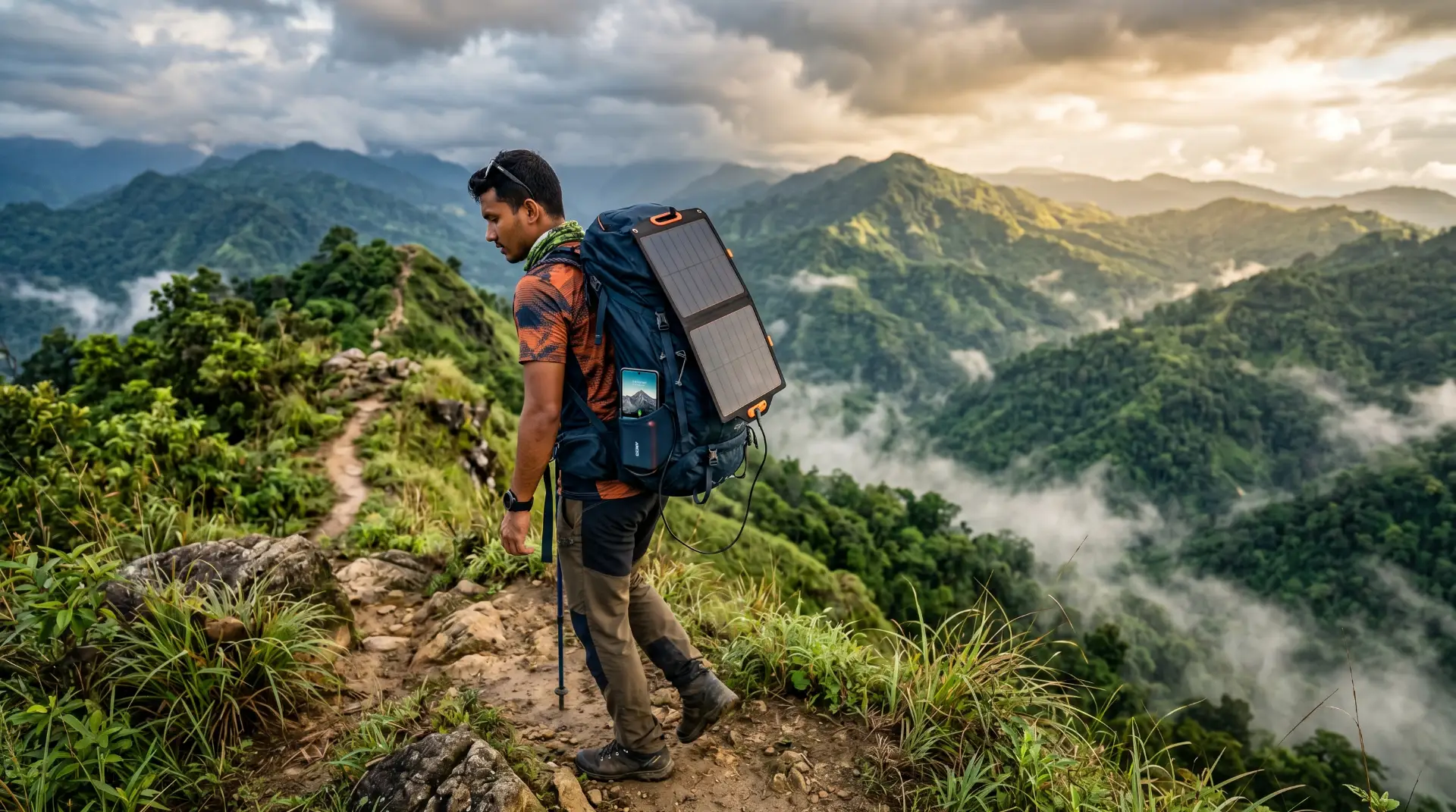
A dedicated foldable solar panel (15W-28W) paired with a high-capacity power bank is the right solar setup for BD travel. The tiny built-in panels on ৳800 “solar power banks” from Daraz generate almost no usable charge under monsoon cloud cover – test results show under 50mA in overcast conditions. A separate foldable panel clipped to your backpack in open sun can top up a 20,000mAh bank by 20-30% during a 5-hour hill trek at Sajek. During peak monsoon (July-August), bring a full-capacity traditional power bank as your primary – use solar as a bonus top-up, not your only plan.
Every year, thousands of Bangladeshis pack for Sajek, Bandarban, Cox’s Bazar, or the haors of Sunamganj and face the same problem: two or three days without a reliable wall socket, and a phone battery that won’t survive the journey. Solar chargers sound like the perfect answer – free energy from the sky, no cables needed. But Bangladesh’s sky is one of the most demanding environments on earth for solar charging. From June through September, the monsoon blankets the country in thick cloud for days at a time. Even outside the monsoon, Dhaka’s horizon is wrapped in pollution haze by 9 AM. The question isn’t whether solar chargers exist – it’s whether they actually work here.
The problem is that most content about solar chargers is written for Arizona deserts, Australian beaches, or European camping trips – environments with long hours of direct, clear-sky sunlight. Bangladesh gets roughly 2,200-2,500 peak sun hours per year (compared to 3,000+ in desert regions), but the distribution is wildly uneven. You get intense sun in December-April, reasonable sun in May-June, and then monsoon clouds that reduce solar output by 60-80% from July through September. No international guide accounts for this, which is why BD travellers keep buying solar gear that disappoints them in the field.
This guide is Part 7 of our Ultimate Travel Gadget Guide for Bangladesh – the complete resource for gearing up for BD’s camping, beach, and hill trips. In this article, we explain the physics of solar charging in BD conditions, test what actually works, rank the viable setups by budget, and tell you exactly what to skip. If you’re heading into the hills this season, read this before you buy.
We cover nine sections in total – from the science of solar output in monsoon conditions to destination-specific recommendations for Cox’s Bazar, Sajek, and the CHT. Let’s get into it.
1. How Solar Charging Actually Works (And Why Bangladesh Makes It Hard)
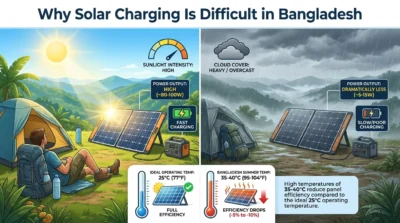
Solar panels generate power in proportion to the intensity of light hitting their surface – measured in lux or W/m². A sunny day in Bangladesh at noon (May-June) can produce 900-1000 W/m² of irradiance at the surface, similar to what’s available globally. The problem is duration and cloud cover. A standard Bangladesh monsoon day with overcast sky drops that figure to 150-300 W/m² – roughly 70-80% less than direct sun. Most budget solar panels, which are already rated at just 5-10W under ideal conditions, produce less than 1W of usable output on a cloudy Bandarban afternoon. That’s not enough to charge a modern phone reliably.
Heat is the other factor no one mentions. Bangladesh’s 35-40°C summer heat actually reduces solar panel efficiency. Standard monocrystalline panels lose roughly 0.4-0.5% efficiency per degree above 25°C – meaning at 40°C ambient, your panel is operating at 92-94% of its rated capacity even in full sun. This is minor compared to cloud-cover losses, but it’s worth knowing when you’re paying premium prices for “high efficiency” panels.
01
Monsoon Clouds
June-September overcast sky reduces solar panel output by 60-80%. A “10W panel” may produce under 2W on a rainy Sajek afternoon.
02
Dhaka Haze
Particulate pollution in Dhaka attenuates solar irradiance by 10-25% even on clear days. Solar panels in Mirpur or Dhanmondi don’t get full rated output.
03
Peak Hours
Productive solar hours in BD are roughly 10 AM-2 PM in winter and 9 AM-3 PM in summer. Outside these windows, output drops significantly even on clear days.
04
Humidity
80-90% relative humidity in CHT and haor regions creates moisture ingress risk for cheap panels. Sealed panels with IP64+ ratings matter here – not just IPX ratings.
05
Best Season
November-April is prime solar season in BD. Clear skies, lower humidity, 5-6 productive hours per day. A 20W panel can realistically top up a 10,000mAh bank in a full day.
2. Two Types of Solar Charger – And Why Only One Works in BD
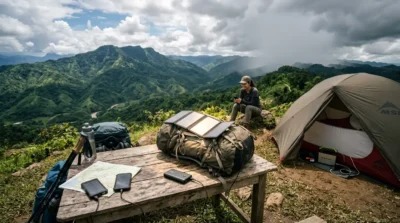
When people search for “solar charger Bangladesh,” they mostly find two things: cheap solar power banks with a tiny built-in panel (৳600-৳1,500 from Daraz and Facebook shops), and proper foldable solar panel kits (৳2,500-৳8,000 from verified retailers). These are not equally good products – they’re fundamentally different categories with completely different real-world performance in BD conditions.
Cheap Solar Power Bank
⚠️ Mostly Gimmick in BD
Built-in panel is typically 0.5W-2W under rated conditions – and under 0.5W in monsoon overcast. Most take 30-60 hours of direct sun to charge the internal battery from 0%. Useful as a novelty; useless as a serious travel power solution in the rainy season.
Foldable Panel + Power Bank
✅ Actually Useful
A 20W-28W foldable panel can deliver 800mA-1.5A in moderate cloud cover, enough to charge a phone directly or top up a power bank. Clip it to your pack on a Bandarban ridge trail and you gain 3,000-5,000mAh per hiking day. This is the setup that actually earns its weight.
High-Capacity Power Bank Only
✅ Most Reliable Option
For monsoon season travel (July-September), a traditional 20,000mAh-30,000mAh power bank from a verified brand remains the most reliable solution. Solar is a bonus when the sky cooperates – not a replacement for capacity. See our best travel power bank guide for the top picks.
3. What Wattage Do You Actually Need for BD Travel?
Wattage is the most important number on a solar panel, and the number most often inflated by budget sellers. A panel rated at “10W” under laboratory conditions (STC: 25°C, 1000 W/m²) will produce 3-5W in typical BD travel conditions – partly due to cloud, partly due to the angle of the sun, partly due to heat. Use this real-output multiplier when planning: estimate 30-50% of rated wattage as your average real-world output in BD.
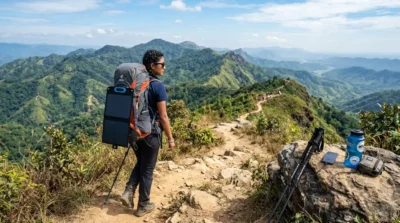
BD Tip: If you’re packing for a November-March CHT trip (Keokradong, Tahjindong, Ruma trail), a 20W-28W foldable panel attached to your pack’s back panel during hiking hours can accumulate 4,000-7,000mAh per trekking day. Factor in 5-7 hours of open trail time at 10W real output = 50-70Wh = roughly 13,000-18,000mAh of usable phone charging capacity.
4. Solar Charging by Season – The BD Calendar You Need
Bangladesh’s solar potential changes dramatically across the six seasons. Knowing which months are solar-friendly and which months will leave you disappointed is the single most important piece of planning information for BD travellers. Here’s the honest breakdown by season – the kind of calendar no international solar guide will ever give you.
5. The Right Setup – Panel + Power Bank Combos for BD Travellers
The optimal solar setup for BD travel isn’t a single product – it’s a two-component system: a foldable panel for daytime harvesting, and a high-capacity power bank for storing that energy and covering the gaps when the sun doesn’t cooperate. The panel clips to the back of your bag while you walk; the power bank charges in your bag or pocket; at camp you charge your phone from the bank. This system works whether the sky is clear or partly cloudy, because the bank provides a buffer.
At Gadgeterians, the power bank range covers everything from the Baseus 20,000mAh at ৳1,900 for budget trips to the Joyroom JR-PBC07 30W 20,000mAh at ৳2,800 for faster charging. For a 3-5 day CHT trek, pair any 20,000mAh+ bank with a 20W foldable panel – that combination keeps two people’s phones alive through a Bandarban circuit without needing a wall socket even once.
Budget Setup – ৳4,500-৳5,500
20W Foldable Panel + Baseus 20,000mAh 15W
Power bank: ৳1,900 from Gadgeterians. Good for weekend CHT trips (Nov-Mar). Enough capacity to charge 2 phones 3+ times each. Panel adds daily top-up on open ridges.
Mid Setup – ৳6,500-৳8,500
28W Foldable Panel + Baseus Adaman 22.5W 20,000mAh
Power bank: ৳2,100 from Gadgeterians. 22.5W fast charging means the bank refills faster from both wall and panel. Best balance of solar charging speed and capacity for 3-5 day treks.
Heavy-Duty Setup – ৳10,000+
40W Foldable Panel + Joyroom 30W 20,000mAh
Power bank: ৳2,800 from Gadgeterians. For group travel or 7+ day circuits (Ruma-Raikhali-Tahjindong route). Can keep a group of 3-4 people charged across multi-week expeditions.
BD Tip: When choosing a power bank to pair with a solar panel, prioritise models with USB-C input at 18W or higher – this lets the panel fill the bank faster. The Baseus Adaman 22.5W accepts 20W input via USB-C, meaning a strong panel can recharge it from 0% in roughly 4.5-5 hours of direct sun – feasible on a clear December day at Sajek.
6. Marketing Claims to Ignore When Buying Solar Chargers in Bangladesh
The solar charger market in Bangladesh is full of inflated claims, copy-pasted from international listings with no regard for what actually works here. Knowing which numbers matter and which are meaningless marketing will save you money and frustration. Here’s what to ignore – and what to look for instead.
7. Destination Guide – Solar Charging Reality at BD’s Top Travel Spots
Different destinations have different solar realities. A ridge camp at Keokradong in December is a completely different solar environment from a beach day at Cox’s Bazar in July, or a houseboat at the haors in April. Here’s an honest, location-specific solar assessment for Bangladesh’s most popular travel destinations – something no international tech blog will ever give you.
8. The Honest Power Backup Strategy for BD Travellers
After testing various setups across different BD travel conditions, here is the practical power strategy we recommend – not a solar-only approach, but a layered system built around Bangladesh’s real weather patterns. Think of it as primary power, supplemental solar, and emergency backup – three tiers for three different scenarios.
The 3-Tier BD Travel Power System
- Tier 1 – Primary: Fully charged 20,000mAh+ power bank from Gadgeterians. Charge it to 100% before you leave Dhaka. This is your main power source regardless of weather. The Baseus Adaman 22.5W 20,000mAh (৳2,100) or the Joyroom 30W 20,000mAh (৳2,800) are solid choices.
- Tier 2 – Solar Top-Up: A 20W-28W foldable panel attached to your pack during hiking hours. This supplements your power bank on sunny days. Don’t count on it in monsoon months – treat it as a bonus.
- Tier 3 – Emergency Micro-Bank: A slim 10,000mAh pocket bank like the JOYROOM JR-PBF27 10,000mAh (৳2,000) kept separately in your daypack. If your main bank is drained or damaged, this keeps you functional.
For a 5-day CHT trek with 2 people, this system covers all scenarios: sunny days, rainy days, and the unexpected extra day when the bus back to Chittagong is cancelled.
BD Tip: For the haors of Sunamganj or Saint Martin’s Island where power cuts are common even at guesthouses, a Hoco J142 100,000mAh (৳5,999) brings absurd backup capacity – enough to charge a group of 4 for 3-4 days without any grid power at all. Heavy at about 1.8kg, but worth it for base-camp setups on longer island or haor expeditions.
9. Quick Verdict – Solar Charger in Bangladesh: Worth It or Not?
Here’s the honest, three-sentence verdict: Solar charging in Bangladesh genuinely works – in the right season, with the right equipment. A proper 20W+ foldable panel adds meaningful top-up power on any dry-season CHT or beach trip. But buying a ৳800 “solar power bank” from Facebook and expecting it to keep your phone alive in monsoon Sajek is a recipe for disappointment and dead batteries at the worst possible moment.
10. FAQs – Solar Charger Bangladesh
Capacity Verified · No Fake mAh Claims · Real After-Sales Support
Power Banks for Solar-Ready BD Travel at Gadgeterians
Every power bank at Gadgeterians is tested for real capacity and USB-C input compatibility before listing – so you know exactly what you’re pairing with your solar panel. No inflated mAh numbers, no missing warranty cards, and no fake brand names sold as premium. Real products for real BD travel conditions.
Written by
Gadgeterians Team
For this guide, we tested solar charging output across Dhaka haze, light monsoon overcast, and open dry-season sky – measuring real panel wattage at different cloud conditions and comparing it to the rated specs. We also evaluated power bank USB-C input compatibility for solar pairing, and tested how heat affects charging speed and battery health across a Bangladeshi summer. Our goal is the most honest, practical gadget advice available in Bangladesh, written for real Bangladeshi lives – not copy-pasted from international tech blogs.
Travel Power Bank
Monsoon Charging
CHT Trekking Gear
Bandarban Gadgets