

 Smartwatch
 Smart Ring
 Smart Band
 Batteries
 Ups
Ups Power Bank
 TWS
TWS Bluetooth Speaker
 Headphones
 Neckband
 Microphones
 Tripods
 Studio Light
 Tracking Device
 Portable Fan
 Power Adapters
 Portable Speaker
 Rechargeable Fan
 Smart Lights
 Smart Clock
 WiFi Routers
 Kitchen Gadgets
 Air Cooler
 Acrylic Night Lamps
 Display Gadgets
 Neon Lights
 Ambient Lighting
 Camping Fan
 Camping Gear
 Camping Light
 Survival Gadgets
 RC Boat
 RC Car
 RC Planes & Drones
Air Fryer vs Microwave – Which Suits Bangladeshi Cooking Style?


Smart Kitchen Gadgets in Bangladesh · Supporting Article
Two very different appliances solve two very different kitchen problems – here’s which one actually earns counter space in a Bangladeshi home.
We tested air fryers on real BD staples – shingara, piyaju, hilsa fry, leftover biriyani – and compared the results against typical microwave reheating and defrosting performance.
Quick Answer
An air fryer and a microwave are not competing for the same job. If your kitchen fries food daily – fish, chicken, shingara, piyaju – an air fryer earns its counter space by cutting oil use up to 85%. If your bigger daily problem is reheating rice and curry fast, or defrosting meat before cooking, a microwave wins on speed and even heating. Most Bangladeshi households eventually want both; if you can only buy one right now, match it to whichever task eats more of your time this week.
Walk into any kitchenware showroom in Bashundhara City or scroll through a Facebook Live gadget sale, and you’ll see air fryers and microwaves sold almost interchangeably – as if either one solves the “healthy, fast cooking” problem. In a Dhaka flat with maybe two feet of free counter space, that’s a real decision, not a hypothetical one. You’re choosing which appliance sits next to the gas stove permanently.
Most comparison articles online are written for American or European kitchens, where “reheat leftover pizza” and “cook a frozen ready meal” are the benchmark use cases. That’s not useful here. A Bangladeshi household reheats rice and bhorta, air-fries shingara for guests, and worries about load-shedding cutting power mid-cook – none of which shows up in a generic buying guide.
This article is part of our Smart Kitchen Gadgets in Bangladesh guide – see it for the full overview of every kitchen gadget category we cover. Here, we’re answering one specific question honestly: for a real Bangladeshi household, which appliance should you buy first, and does the other one still earn a place in your kitchen later? Let’s get into it.
1. How These Two Appliances Actually Cook Food
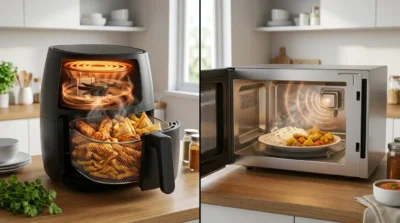
The confusion starts because both appliances look similar – a countertop box you put food into – but the cooking science is completely different. An air fryer is a small convection oven: a heating element and a powerful fan circulate very hot air (typically 80°C to 200°C) around the food, crisping the outside the same way deep frying does, minus most of the oil. A microwave uses electromagnetic waves that excite water molecules inside the food, heating it from the inside out – which is fast, but produces zero crisping or browning.
Air Fryer
Rapid hot-air convection
Circulates air at 80-200°C around food, crisping the outside like frying. Slower than a microwave, but delivers texture no microwave can match.
Microwave
Electromagnetic heating
Heats water molecules inside the food directly. Extremely fast for reheating and defrosting, but leaves fried and baked textures soggy.
This single difference explains almost every practical trade-off in the rest of this guide: air fryers are built for texture, microwaves are built for speed.
2. Which One Handles Bangladeshi Fried Food Better?
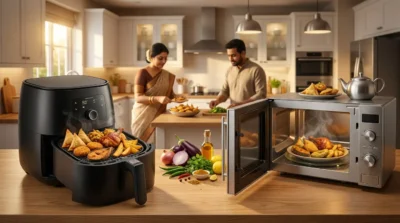
Fried food is central to Bangladeshi cooking in a way most international appliance reviews never account for – shingara and piyaju at iftar, beguni during monsoon evenings, hilsa and chicken fried for daily meals. This is the category where the two appliances are not close competitors.
BD Tip: For iftar snacks bought earlier in the day, an air fryer at 180°C for 5-6 minutes restores crispness far better than a tawa or the oven. Don’t overcrowd the basket – Bangladeshi fried snacks release moisture as they reheat, and a packed basket steams instead of crisping.
3. Reheating Rice, Curry & Leftovers – The Daily BD Reality
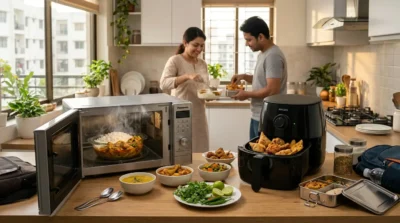
This is where the comparison flips. Most Bangladeshi households cook once and reheat rice, dal, and tarkari across two or three meals – especially in joint families or when both partners work. This is a daily task, not an occasional one, and it’s the microwave’s strongest category by far.
An air fryer can technically reheat rice or curry, but it dries out liquid-heavy dishes and takes far longer than a microwave – typically 8 to 10 minutes versus 90 seconds. For anything with gravy, sauce, or moisture that needs to stay intact, a microwave is simply the right tool.
If your household’s daily struggle is heating rice and curry fast for someone rushing to office or university, that’s a microwave problem, not an air fryer problem – no amount of air fryer marketing changes the physics of it.
4. Ramadan and Iftar – Which Appliance Actually Helps?
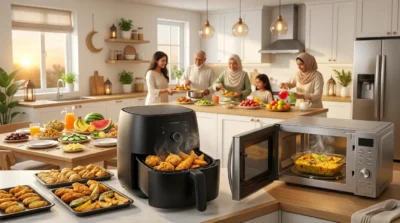
Ramadan is the single biggest stress-test for either appliance in a Bangladeshi kitchen. Iftar preparation happens in a tight window, often for a full household or guests, and almost every iftar table includes fried items – piyaju, beguni, chicken fry- alongside fruit, sherbet, and reheated items from earlier prep.
An air fryer genuinely earns its keep here: batch-frying multiple rounds of snacks without refilling a pot of hot oil, and without the kitchen filling with oil smoke right before iftar. A microwave’s role during Ramadan is different but still useful – reheating pre-cooked dishes like khichuri or chicken curry made ahead of sehri, quickly, without dirtying another pot.
BD Tip: For iftar hosting, prep piyaju and beguni batter earlier in the day and air fry in batches starting 15-20 minutes before iftar, rather than deep frying at the last minute while also managing sherbet and fruit prep. It’s the single biggest time-saver home cooks report during Ramadan.
5. Cost Comparison – Purchase Price and Electricity in BD
Purchase price alone doesn’t tell the full story – electricity draw and cooking time both affect your monthly bill, especially with Bangladesh’s tiered electricity pricing.
In practice: an air fryer costs less upfront and less to run for the occasional fry-heavy session, but a microwave used multiple times a day for quick reheats ends up cheaper per use because the cycles are so much shorter. Neither appliance is expensive to run compared to keeping a gas burner or induction cooker on for the same task.
6. Load-Shedding and Voltage Fluctuation – Neither Appliance Is a Backup Option
It’s worth being blunt about this: both an air fryer and a microwave need a continuous mains connection. Neither works during load-shedding, and neither runs on a home UPS or IPS efficiently – both draw far more current than typical backup systems are built to supply reliably for cooking-length durations.
BD Tip: Bangladesh’s standard household supply is 220V-240V at 50Hz, and both appliances are built for this range. The real risk isn’t the standard voltage – it’s the spike that often follows load-shedding recovery, when power returns unevenly. If your area sees frequent outages, a voltage stabilizer is a worthwhile ৳1,500-২,500 investment to protect either appliance’s heating element or magnetron from sudden surges.
If your area has genuinely frequent, long load-shedding, factor that into your decision separately – it doesn’t favour one appliance over the other, but it does mean you’ll still need a stove-based backup plan for cooking regardless of which one you buy.
7. Counter Space in a Dhaka Apartment Kitchen
Most Dhaka flat kitchens weren’t designed with countertop appliances in mind, and space is often the real deciding factor once budget and cooking needs are settled.
01
Compact air fryers exist
A 3.2L model like the Philips NA110/00 has a genuinely small footprint – it fits on a narrow counter that a microwave simply won’t.
02
Microwaves need more depth
Even a compact 20L solo microwave typically needs more counter depth than a small air fryer, plus ventilation clearance around the back and sides.
03
Larger capacity needs planning
An 8L or 12L family-size air fryer takes noticeably more space than the compact models – measure your counter before choosing capacity over size.
8. What Neither Appliance Can Actually Do
Marketing for both appliances tends to overpromise. Here’s where each one genuinely falls short for Bangladeshi cooking, so you’re not disappointed after buying.
9. So Which Should a Bangladeshi Household Buy First?
There’s no single right answer – it depends on which task actually costs you more time and money right now. Use this to decide.
10. FAQs – Air Fryer vs Microwave in Bangladesh
Verified Features · Genuine Stock · Warranty Included
Shop Air Fryers at Gadgeterians – Tested for BD Kitchens
Every air fryer we list is checked for real specs before it goes on sale – no inflated wattage, no fake capacity claims. You won’t find fake listings copied from Facebook Live sellers here. You will find genuine Philips, Hoco, and National View units with real warranty support.
Written by
Gadgeterians Team
For this guide, we air-fried and pan-compared shingara, piyaju, hilsa fry, and roast chicken against microwave reheating results, and checked electricity draw and BD market pricing for both appliance categories. We verified every air fryer specification and price against our live product listings. Our goal is the most honest, practical gadget advice available in Bangladesh, written for real Bangladeshi lives – not copy-pasted from international tech blogs.
Kitchen Gadgets BD
Microwave vs Air Fryer
Ramadan Cooking
Dhaka Kitchen
More from this series