

 Smartwatch
 Smart Ring
 Smart Band
 Batteries
 Ups
Ups Power Bank
 TWS
TWS Bluetooth Speaker
 Headphones
 Neckband
 Microphones
 Tripods
 Studio Light
 Tracking Device
 Portable Fan
 Power Adapters
 Portable Speaker
 Rechargeable Fan
 Smart Lights
 Smart Clock
 WiFi Routers
 Kitchen Gadgets
 Air Cooler
 Acrylic Night Lamps
 Display Gadgets
 Neon Lights
 Ambient Lighting
 Camping Fan
 Camping Gear
 Camping Light
 Survival Gadgets
 RC Boat
 RC Car
 RC Planes & Drones
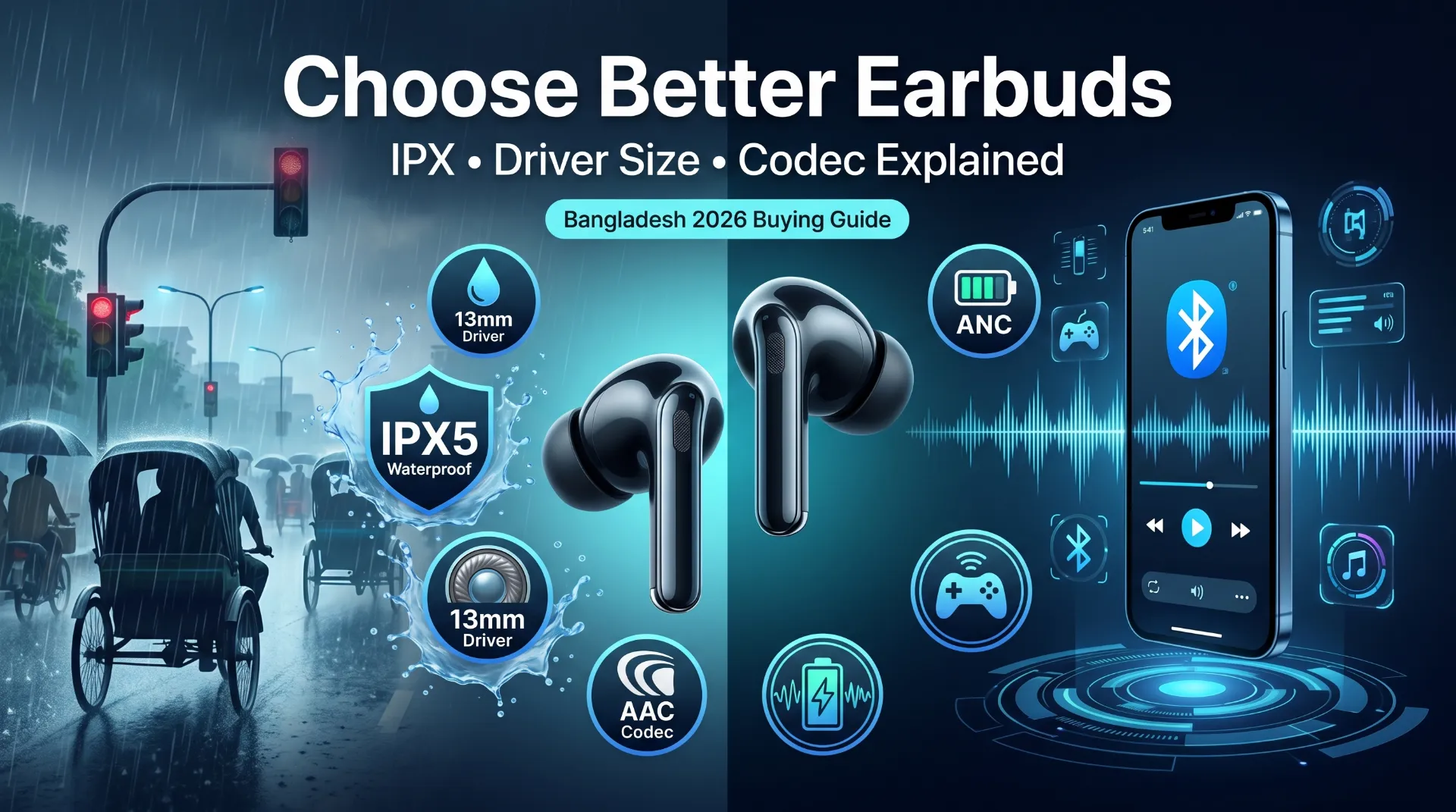
How to Choose Earbuds in Bangladesh – IPX, Driver Size & Codec Explained

Audio Buying Guide Bangladesh · Supporting Article
Cut through the spec-sheet noise. This guide tells you exactly what IPX ratings, driver sizes, and Bluetooth codecs actually mean for buying earbuds in Bangladesh in 2026.
Tested across Dhaka commutes, monsoon conditions, and gym use. We checked claims made by popular earbuds sold in BD and separated the useful specs from marketing fluff.
Quick Answer
For Bangladesh use, prioritise IPX4 or higher (monsoon rain and sweat protection), a 10mm+ dynamic driver for satisfying bass, and SBC or AAC codec (both work on every BD phone). ANC is only worth paying for above ৳3,000 – cheap ANC in ৳1,000-৳2,000 earbuds is mostly marketing. Driver size alone doesn’t determine sound quality; tuning, codec, and waterproofing all matter more for everyday BD life.
Stand in the earbuds section at Bashundhara City or scroll through any BD Facebook group, and you’ll see the same claims everywhere: “13mm bass driver!”, “IPX7 waterproof!”, “aptX HD codec!” – all on boxes priced at ৳900. Meanwhile, a Realme Buds Air 5 Pro at ৳7,000+ features 50dB ANC and a 6mm micro-planar tweeter. If you don’t know what these specs actually mean, there is no way to tell which product is worth your money and which one is just good marketing.
The problem is that almost every earbuds buying guide online is written for global markets – UK weather, iPhone-dominated regions, and people who never encounter a June monsoon or 90% humidity. The specs that matter for a Dhaka daily commuter on a CNG, a student attending online classes in Mirpur, or someone heading to Cox’s Bazar for the weekend are completely different from what a reviewer in London recommends.
This guide is part of our Ultimate Audio Buying Guide for Bangladesh 2026. Here, we break down every major earbuds spec – IPX waterproof ratings, driver sizes, Bluetooth codecs, ANC quality, latency, and battery claims – and tell you honestly which ones matter in Bangladesh and which ones you can safely ignore.
We also reference real products available at Gadgeterians so you can see how these specs translate to actual options at every price tier. Let’s decode the jargon – starting with the one that matters most in Bangladesh.
1. IPX Waterproof Ratings – The Most Important Spec for Bangladesh
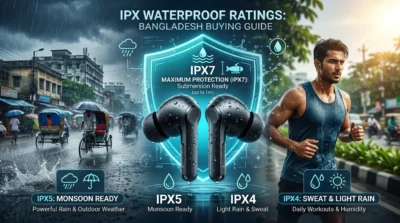
Bangladesh gets 2,300mm+ of rainfall annually, concentrated in a four-month monsoon. Add in Dhaka’s 35°C+ summer heat, the sweat from even a 10-minute rickshaw ride, and the spray from roadside puddles during rains – earbuds without proper waterproofing are a liability, not a gadget. IPX is the international standard for water resistance, and understanding it takes about two minutes.
The “IP” stands for Ingress Protection. The first digit covers dust (often replaced by “X” meaning not tested), and the second digit covers water. Most earbuds show ratings like IPX4, IPX5, or IPX7. Here’s what each actually means in real BD conditions:
BD Tip: Many no-brand earbuds on Daraz and Facebook live sellers falsely claim IPX7 or even IP68. A real IPX7 product must have completed a standardised test – check for official brand documentation or buy from a verified source. Gadgeterians only lists earbuds with confirmed waterproof ratings from the manufacturer.
2. Driver Size – What It Actually Tells You (And What It Doesn’t)
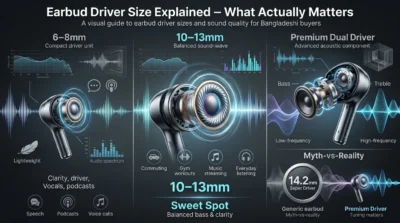
The driver is the speaker inside the earbud. Measured in millimetres, it converts the electrical signal into the sound waves your ears hear. Bangladeshi buyers often equate larger driver = louder, better bass – and while there’s truth there, the relationship is far less direct than most listings suggest.
A well-tuned 6mm driver from a quality brand will outperform a poorly-tuned 14mm driver from a no-name factory. That said, for budget earbuds (৳1,000-৳3,000) where tuning is often basic, driver size does give a rough indicator of bass potential. Here’s a practical breakdown for the BD market:
6-8mm
Compact Clarity Driver
Common in sleep-friendly earbuds (like HOCO EW65 with its 6mm unit). Lighter bass response but cleaner mids and highs. Good for podcasts, voice calls, and classical music. Not ideal if you like heavy Bengali fusion or rap.
10-13mm
The Sweet Spot for BD
The most common range for quality mid-range earbuds like the HOCO EQ2 (13mm) and Awei T56 ANC (10mm). Balances bass and clarity well. Ideal for commuting, gym sessions, and general use. Most buyers in the ৳1,500–৳4,000 tier should look here.
Dual Driver
Premium Tier Quality
Products like the Realme Buds Air 5 Pro use a coaxial dual-driver setup (11mm bass + 6mm micro-planar tweeter) to cover both lows and highs separately. This genuinely improves quality at the ৳6,000+ tier – not marketing fluff at this level.
3. Bluetooth Codecs Explained – SBC, AAC, aptX, LDAC
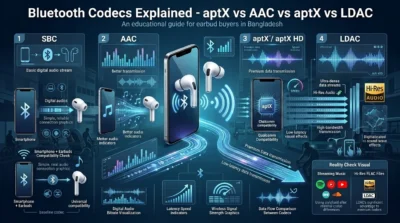
A Bluetooth codec is the method used to compress and transmit audio from your phone to your earbuds. The codec directly affects audio quality and latency – and this is where a lot of Bangladeshi buyers get misled by specs that sound premium but don’t actually apply to their device.
Here’s the critical thing most guides don’t say clearly: both your phone AND your earbuds need to support the same codec, otherwise they fall back to SBC. On most Android phones in Bangladesh – Samsung Galaxy A series, Xiaomi Redmi, Realme, Symphony, Walton – your phone determines the supported codecs, and that affects what you can actually hear.
BD Reality Check: If you stream music via YouTube Music, Spotify, or Bongo on a Grameenphone or Robi connection, you are not streaming lossless audio. The difference between SBC and LDAC is invisible at typical streaming bitrates. LDAC only matters if you have locally stored FLAC files and a phone that supports Android’s LDAC output.
4. ANC vs ENC – Which One Do You Actually Need?
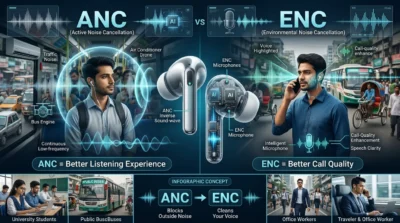
ANC (Active Noise Cancellation) and ENC (Environmental Noise Cancellation) appear on earbuds at almost every price point in Bangladesh now. But they are very different technologies serving different purposes – and which one matters more depends entirely on how you use your earbuds in BD daily life.
ANC – Active Noise Cancellation
For Music Listening
Uses microphones to sample ambient noise and generates inverse sound waves to cancel it. Reduces constant background noise – Dhaka traffic hum, AC unit drone, engine sounds on a bus. Most effective at low-frequency continuous sounds. Real ANC (≥25dB) only works well above ৳3,000 in Bangladesh. Below that, it’s often a marketing label on single-mic passive isolation.
ENC – Environmental Noise Cancellation
For Call Quality
Processes the microphone signal to reduce noise picked up during calls. This is the technology that makes your voice sound clear to the person on the other end – even if you’re calling from a noisy Dhaka street or during a rickshaw ride. ENC works at lower price points (from ৳1,500) and is genuinely useful for most BD buyers who frequently make calls in noisy environments.
Products like the HOCO EQ22 and HOCO EQ26 available at Gadgeterians offer ANC+ENC as a hybrid, making them a strong value choice if you want both call clarity and some background noise reduction. The Realme Buds Air 5 Pro takes it further with 50dB ANC, which is genuinely useful for long Dhaka commutes or working in a noisy office in Motijheel.
If your primary use is calling and online classes – which is a very common case for BD university students – prioritise ENC over ANC. Good ENC at ৳2,000 beats weak ANC at the same price every time.
5. Battery Life – Honest Numbers for Bangladesh Use
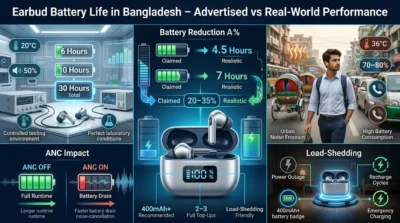
Battery life claims on earbuds packaging are almost always measured at 50% volume in a lab environment at 20°C. Dhaka in June is 36°C and you listen at 70-80% volume because of traffic noise. Expect real-world battery life to be 20-35% lower than advertised figures. Here’s a practical way to read the specs:
How to Interpret Battery Claims for Bangladesh
- Earbud playtime (e.g. “6 hours”) – Subtract 20-30% for real BD use (heavy volume, call use, hot weather). 6 hours = ~4.5 hours realistic.
- Total with case (e.g. “30 hours”) – This includes the charging case. The case charges your earbuds 3-4 times typically.
- ANC ON vs OFF – Running ANC reduces battery by 25-40% on most earbuds. Budget ANC earbuds may drop from 6 hours to 3.5 hours.
- During load-shedding – Charge your case during power-on periods. A fully charged 400mAh+ case gives 2-3 full top-ups even without mains power.
Load-Shedding Tip: If your area has 4–6 hours of daily load-shedding, choose earbuds with a charging case of at least 400mAh. A case this size gives you a full top-up even if you can’t charge overnight. The HOCO EQ13 and HOCO EQ26 both come with adequately sized cases.
6. Bluetooth Version – Does 5.3 vs 5.4 Actually Matter?
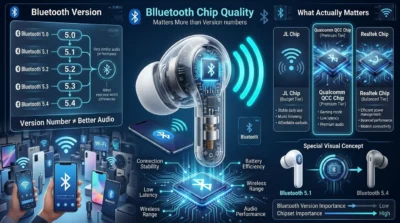
Short answer: above Bluetooth 5.0, the version number makes minimal real-world difference for earbuds. Bluetooth 5.0, 5.1, 5.2, 5.3, and 5.4 are all backwards-compatible and all offer more than enough bandwidth for audio. The differences between these versions involve power efficiency, location features, and protocol improvements that earbuds barely use.
What actually matters more than the version number: the Bluetooth chip inside. A budget chip running BT 5.4 can perform worse than a good chip running BT 5.1. Most earbuds in the BD market use one of these chips:
JL
JieLi (JL) Chips
Widely used in budget BD earbuds including HOCO range. Stable connection, decent latency, good enough for everyday listening. Not the best for gaming.
QCC
Qualcomm QCC Chips
Found in premium earbuds. Low latency (~40ms), aptX support, good power management. More stable in crowded wireless environments like Bashundhara City.
RTL
Realtek Chips
Common in Realme, Xiaomi earbuds. Good balance of power, latency, and features. The Realme Buds Air 5 Pro uses proprietary chipsets for their low-latency gaming mode.
7. Latency – Critical for PUBG & Free Fire Players in BD

Audio latency is the delay between what happens on screen and what you hear in your earbuds. For music and calls, 150-200ms latency is unnoticeable. For PUBG Mobile, Free Fire, and Call of Duty Mobile – which are the three most-played mobile games in Bangladesh – even 120ms can mean the difference between hearing footsteps before you’re shot or after.
Most standard earbuds have 150-300ms latency in normal mode. Good gaming earbuds with a dedicated low-latency or “Game Mode” drop this to 40-80ms. For serious gaming, look for earbuds that explicitly advertise a low-latency game mode – like the Realme Buds Air 5 Pro with its 40ms game mode. If gaming is not your priority, don’t pay a premium just for this feature.
Under 80ms
✅ Good for Gaming
Competitive gaming standard. Earbuds with a dedicated game mode usually achieve this. Worth paying for if you play PUBG or Free Fire daily.
80–150ms
⚠️ Acceptable
Noticeable delay during gaming but fine for YouTube, streaming, and music. Most mid-range TWS earbuds fall here in standard mode.
200ms+
❌ Avoid for Gaming
You’ll clearly notice lips not syncing with speech in videos. Unusable for competitive mobile games. Common on very cheap ৳500-৳900 TWS earbuds.
8. Earbud Fit Types – Which One Works in Bangladeshi Conditions
Fit affects both comfort and how the earbuds perform in BD conditions – specifically, sweat retention during heat, stability during commuting, and whether sound leaks on packed buses and CNG rides. There are three main fit types in the BD market right now:
Wudu & Prayer Use: If you regularly make wudu and want to keep earbuds in or nearby during prayers, IPX5+ and a quick-dry silicone tip are important. Open-ear designs also dry faster after water contact. See our TWS vs Neckband comparison for more on daily wearability.
9. What NOT to Buy – Marketing Claims That Fail in Bangladesh
The BD earbuds market has a significant problem with fake specs and misleading claims – particularly on Daraz, Facebook live sellers, and small Jamuna Future Park stalls. Here are the specific claims we’ve verified to be consistently misleading in the ৳500-৳2,000 segment:
10. Earbuds by Use Case – Which Spec Profile to Look For
Rather than chasing a single best earbud, different use cases in Bangladesh call for completely different spec priorities. Here’s a practical, BD-specific breakdown of what to actually prioritise:
11. BD Budget Tier Guide – Right Specs for Each Price Range
Understanding specs is only useful if you know what to realistically expect at each price tier available in Bangladesh. Here’s an honest summary based on products actually tested by our team – not theoretical benchmarks:
12. FAQs – Earbuds Specs & Buying in Bangladesh
Verified Specs · Genuine Stock · 7-Day Replacement Guarantee
Shop Earbuds at Gadgeterians – No Fake Specs, No Inflated Claims
Every earbud we list has been checked for authentic IPX ratings, confirmed codec support, and real driver specifications. We don’t carry no-brand earbuds with fabricated waterproof claims. Cash on delivery available across all 64 districts, with fast dispatch from Dhaka.
Written by
Gadgeterians Team
For this guide, we tested earbuds across daily Dhaka commutes, gym sessions in 35°C heat, and simulated rain exposure to verify IPX rating claims. We cross-checked codec compatibility on popular BD phones including Samsung Galaxy A-series, Xiaomi Redmi, and Realme devices. Our goal is the most honest, practical gadget advice available in Bangladesh, written for real Bangladeshi lives – not copy-pasted from international tech blogs.
IPX Rating Guide
Bluetooth Codec
TWS Audio Guide
ANC vs ENC
