How to check your load shedding schedule, plan around it, and build a complete gadget kit so outages stop disrupting your life
The power will be cut again tonight. Here is how to know exactly when – and how to be fully ready when it does.
Updated: April 2026 · 13 min read · Verified by Gadgeterians Team
Quick Answer
Check your load-shedding schedule at dpdc.org.bd (Dhaka) or desco.org.bd (Dhaka north) or your local BPDB office number – schedules are posted area-by-area and updated weekly. For the gadget kit: at minimum, you need a rechargeable fan (৳2,500-৳4,500), a rechargeable lamp or lantern (৳1,200-৳2,200), a Mini UPS to keep your WiFi alive (৳800-৳1,500), and a 20,000mAh power bank for phones (৳2,000-৳3,500). Total for a basic functional kit: ৳6,500-৳12,000. This guide covers the schedule sources, a room-by-room kit plan, and exactly what to buy at every budget level.
Load-shedding in Bangladesh is not random – at least not entirely. DPDC, DESCO, and BPDB publish area-wise schedules that tell you which zone loses power and for how long each day. Most people never look at these. They just get surprised every time the lights go out, fumble for their torch, and wait it out in the heat.
The difference between a family that survives load-shedding comfortably and one that does not is rarely money – it is preparation. A ৳8,000 gadget kit assembled correctly keeps you cool, lit, connected, and working through a 3-hour outage. The same ৳8,000 spent randomly on unrelated gadgets gives you nothing useful when the power cuts.
This guide does two things: first, it shows you exactly how to find and use Bangladesh’s actual load-shedding schedule resources. Second, it lays out a complete, priority-ordered gadget survival kit – from the ৳6,500 starter setup to the ৳25,000+ full home backup – with links to every dedicated product guide we have written in this series.
This article is the hub guide for the entire load-shedding series at Gadgeterians. Every product category links out to a dedicated in-depth guide. If you want the full story on any single product – rechargeable fans, power banks, UPS units, backup lighting – follow those links. Here, we cover the complete picture.
1. How to Check the Load-Shedding Schedule for Your Area in Bangladesh
Bangladesh’s power distribution is handled by different entities depending on where you live. Finding the right schedule depends on which utility covers your area:
| Your Location | Utility | Where to Check the Schedule | Contact |
|---|
| Dhaka South (Motijheel, Lalbagh, Demra, Postogola) | DPDC | dpdc.org.bd → Load Shedding Schedule | 16199 |
| Dhaka North (Gulshan, Mirpur, Uttara, Bashundhara) | DESCO | desco.org.bd → Load Shedding | 16116 |
| Chittagong | CPGCBL / BPDB | bpdb.gov.bd or local circle office | Local office |
| Sylhet, Rajshahi, Khulna, Barisal, Mymensingh | BPDB (regional) | bpdb.gov.bd → Division → District | Local circle |
| Rural areas and districts outside major cities | BPDB / REB (Rural Electrification Board) | reb.gov.bd or local PBS (Palli Bidyut Samity) office | Local PBS |
Practical Tip: The Schedule Is Updated Weekly
DPDC and DESCO publish schedules in zones – your area will be assigned to a zone (e.g., Zone A, B, C) that rotates throughout the day. Schedules are usually updated on Sunday for the coming week. The schedule shows 1-3 hour outage windows per zone per day. Bookmark your utility’s schedule page and check it once a week – this 2-minute habit removes all the surprise from load-shedding.
Faster Method: Ask Your Building’s Caretaker
In apartment buildings across Dhaka, the caretaker (darwan or security guard) usually knows the load-shedding pattern for your block far better than the official website – because they experience it daily. Ask them which hours the power typically cuts off in your building. Cross-reference with the official schedule for accuracy.
2. How to Read and Use the Schedule to Plan Your Day
Knowing the schedule turns load-shedding from a disruption into a manageable inconvenience. Here is how to use it practically:
1
Charge everything before your scheduled window
If your zone cuts at 6 pm, start charging your power bank, rechargeable fan, and lamp by 4 pm. Most devices need 1-2 hours for a full top-up. A 20,000mAh power bank at 5pm is far more useful than one at 10% when the lights go out at 6:01 pm.
2
Identify your “critical hours” – and protect them
If load-shedding falls during your child’s HSC study session (8-10 pm) or your own freelance work window, those hours need extra protection – a brighter lamp, a UPS on the desktop, and a charged fan. If it falls at 2 am when everyone is asleep, a basic emergency light in the corridor is all you need.
3
Plan heavy cooking and laundry around it
Electric rice cookers, washing machines, and water pumps should not be running when load-shedding hits – a sudden cut while the pump is running can damage the motor over time. Check your schedule and run appliances during confirmed power-on windows.
4
Build a simple routine, not a crisis response
The goal is to stop treating load-shedding as an emergency and start treating it as a scheduled appointment. A 5-minute “power preparation” check before your window – devices charged, lamp placed, fan ready – is the difference between a disruption and a minor background event.
3. The 5 Survival Problems Load-Shedding Creates – and the Gadget That Solves Each
Every load-shedding problem maps to a specific gadget category. Building your kit means solving each problem in priority order:
Without the ceiling fan, a Dhaka room in April-September becomes unbearable within 20 minutes.
This is the #1 comfort problem – especially for children, elderly family members, and anyone sleeping.
Solution: Rechargeable table fan (৳2,500-৳4,500)
Complete darkness is dangerous (stairs, bathrooms) and makes any useful activity impossible.
The split is between automatic safety lighting (emergency lights for corridors/bathrooms) and usable work/family lighting (rechargeable lamps and lanterns).
Solution: Rechargeable lamp + emergency lights (৳1,200-৳2,200)
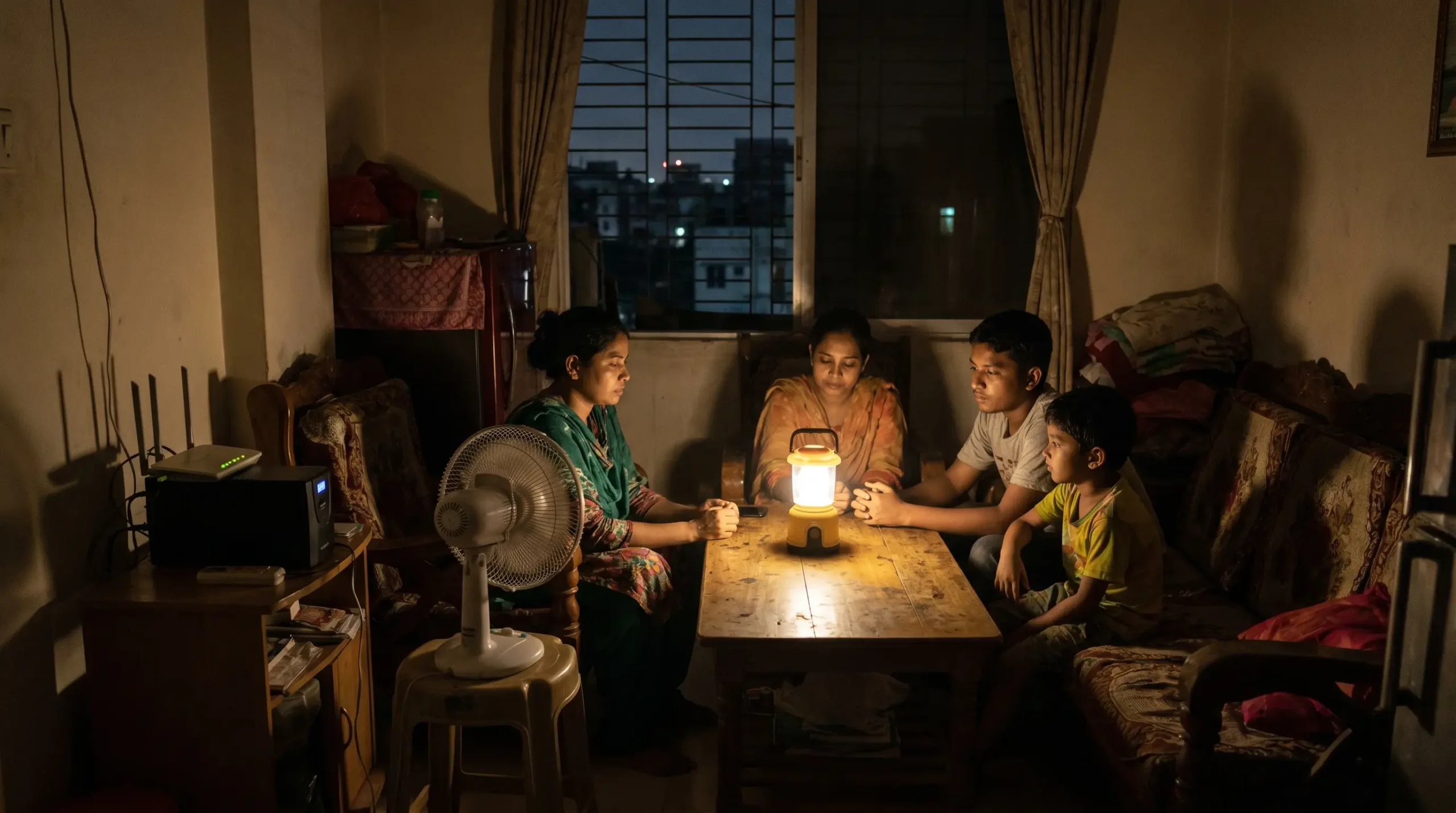
When the power cuts, your router dies – even though your mobile data keeps the world connected, your home network vanishes.
For remote workers, students on video calls, and families streaming, this is often the most immediately disruptive problem. A Mini UPS keeps your router and ONU/ONT running for 4-8 hours on a single charge.
Solution: Mini UPS for router (৳800-৳1,500)
A 3-hour outage during heavy phone use can drain your battery below 20% – and if it happens twice in a day, you start the evening with a nearly dead phone.
A 20,000mAh power bank charges an average smartphone 4-5 times. The key is buying one with real capacity – most advertised mAh figures include a 20-30% loss from conversion.
Solution: 20,000mAh power bank (৳2,000-৳3,500)
🖥️
Problem #5
PC Damage & Data Loss
Desktop computers have no battery – every power cut is an immediate forced shutdown that risks file corruption, SSD wear, and voltage spike damage on restoration.
This only applies to desktop PC users. Laptops have a built-in battery and are naturally protected. A UPS gives desktop users 8-20 minutes to save and shut down properly, plus AVR to regulate voltage at all times.
Solution: Desktop UPS with AVR (৳3,800-৳4,500)
4. Complete Gadget Survival Kit: What to Buy and in What Order
Build your kit in priority order. Buy items 1-4 first – they solve the most critical problems. Add items 5-8 once the basics are covered. Items 9-10 are for households that want zero disruption during extended outages.
| Priority | Gadget | Problem Solved | Price Range (BD) | |
|---|
| 1 | Rechargeable table fan | Heat – the most urgent comfort problem in Bangladesh summers | ৳2,500-৳4,500 | |
| 2 | Rechargeable LED lantern or desk lamp | Usable light for family time, study, cooking, and work | ৳1,200-৳2,200 | |
| 3 | Mini UPS for WiFi router | Keep home internet alive – critical for remote workers and online students | ৳800-৳1,500 | |
| 4 | Power bank (20,000mAh) | Keep phones and tablets charged through multiple outages per day | ৳2,000-৳3,500 | |
| 5 | Emergency lights (2-3 units) | Automatic safety lighting for the bathroom, staircase, and corridor | ৳350-৳600 each | |
| 6 | Desktop UPS with AVR (desktop PC users only) | Protect PC hardware and data from sudden cuts and voltage spikes | ৳3,800-৳4,800 | |
| 7 | Second rechargeable fan (bedroom) | Cover both the living room and the bedroom simultaneously during long outages | ৳2,500-৳4,000 | |
| 8 | Solar panel + power bank combo | Recharge devices during extended outages when even grid power is unavailable | ৳3,500-৳7,000 | |
5. Budget Kit Plans: ৳6,500 Starter / ৳12,000 Comfortable / ৳25,000 Full Coverage
Starter Kit – ৳6,500-৳8,000
MOST IMPORTANT FIRST
Covers the 3 most critical needs: staying cool, staying lit, and keeping the router alive. A single person or couple with a small apartment needs nothing more than this for 2–3 hour outages.
| 1 × Rechargeable table fan | ৳2,500-৳3,000 |
| 1 × Rechargeable LED lantern | ৳1,200-৳1,500 |
| 1 × Mini UPS for router | ৳800-৳1,000 |
| 1 × 10,000mAh power bank | ৳1,500-৳2,000 |
| Total | ৳6,000-৳7,500 |
Who this is for: Bachelors, couples, single-room setups, students in hostel rooms.
Comfortable Family Kit – ৳12,000–৳16,000
RECOMMENDED FOR FAMILIES
Covers the whole family across multiple rooms simultaneously. Everyone has light, airflow, and connectivity – regardless of where they are in the home during a 3-5 hour outage.
| 2 × Rechargeable table fans (living room + bedroom) | ৳5,000-৳8,000 |
| 1 × Rechargeable LED lantern (living room) | ৳1,200-৳1,500 |
| 1 × Rechargeable desk lamp (study room) | ৳1,500-৳1,900 |
| 2 × Emergency lights (bathroom + staircase) | ৳700-৳1,200 |
| 1 × Mini UPS for router | ৳800-৳1,200 |
| 1 × 20,000mAh power bank | ৳2,000-৳3,000 |
| Total | ৳11,200-৳16,800 |
Who this is for: Families of 3-5 in a 2-3 bedroom apartment. Covers all rooms simultaneously.
Full Coverage Kit – ৳22,000-৳30,000+
ZERO DISRUPTION
The complete setup for a household where load-shedding cannot be allowed to disrupt work, study, or daily life. Includes PC protection and the solar setup to handle extended multi-day outages.
| Everything in the Comfortable Family Kit | ৳11,200-৳16,800 |
| 1 × Desktop UPS with AVR (for PC users) | ৳3,800-৳4,800 |
| 1 × Solar panel + compatible power bank | ৳4,000-৳7,000 |
| Additional emergency lights (kitchen, children’s room) | ৳700-৳1,200 |
| Total | ৳19,700-৳29,800 |
Who this is for: Freelancers, remote workers, families with desktop PCs, or anyone in areas with frequent multi-hour outages who cannot afford productivity disruption.
6. Room-by-Room Survival Guide
Different rooms have different needs. Here is what each room in a typical Bangladeshi home needs, and why:
| Room | Essential Gadget(s) | Why / Notes |
|---|
| Living room/dining | Rechargeable fan + LED lantern | This is where the family gathers. The lantern’s 360° output covers the whole room. The fan keeps air moving for multiple people. These are the first two items in any kit. |
| Main bedroom (adults) | Second rechargeable fan + rechargeable desk lamp | Sleeping in 35°C without any airflow is miserable. The desk lamp with warm-white mode is comfortable for reading before sleep without disturbing a partner. |
| Study room/desk | High-lumen rechargeable desk lamp + Desktop UPS (if PC) | 300+ lumens for HSC/SSC study sessions. Flicker-free, eye-protection models reduce strain during 3-4 hour study blocks. If there is a desktop PC, add a UPS – lost assignments are not recoverable. |
| Children’s room | Motion sensor night light + small fan (if hot season) | Children wake up scared in sudden darkness. A motion-sensor light activates automatically when they move without needing to find a switch. Essential for younger children. |
| Bathroom | Emergency plug-in light or motion sensor light | Safety-critical. Navigating a wet bathroom in complete darkness is a fall risk. Automatic activation is essential – you should not have to fumble for a switch. One per bathroom. |
| Staircase/corridor | Emergency plug-in light | Moving between floors in the dark is the most common cause of load-shedding injuries. A ৳400 emergency light prevents this entirely. Non-negotiable for multi-floor homes. |
| Kitchen | Portable lantern (carry from the living room) | Cooking with sharp knives in low light is dangerous. Bring the living room lantern to the kitchen during cooking, or buy a dedicated kitchen unit. Emergency lights at 40 lumens are not bright enough for safe kitchen work. |
| Router/networking corner | Mini UPS (plugged in permanently) | Set it up once and forget it. The Mini UPS charges from the wall and automatically powers your router and ONU/ONT when power cuts. 4-8 hours of WiFi backup from a ৳1,000 device. |
7. What NOT to Buy: Common Gadget Mistakes During Load-Shedding Season
1
A small generator for home use
Petrol generators in apartments produce carbon monoxide – running one on a balcony or in a poorly ventilated room is genuinely dangerous. They are also noisy (disturbing neighbours and violating building rules), expensive to run (petrol cost per hour versus rechargeable gadgets), and require maintenance. For a Dhaka apartment, generators are almost never the right solution. A ৳12,000 gadget kit outperforms a ৳30,000 generator setup for typical 2-4 hour outages.
2
Cheap, no-brand rechargeable fans with inflated battery claims
A ৳1,200 rechargeable fan claiming “8 hours” that delivers 2 hours at low speed is not a deal – it is a waste. We have tested fans for our dedicated guide. Budget fans consistently underperform their specifications by 50-60%. Spend ৳2,500-৳3,500 on a verified brand with a real, tested runtime. The extra ৳1,500 buys you a working fan, not a marketing claim.
3
A 10,000mAh power bank for a family of 4
Four people with smartphones needing daily charges during load-shedding need 20,000mAh minimum – ideally 30,000mAh for multi-device families. A 10,000mAh bank charges 2 phones completely. After the third charge, you are fighting over who gets priority. Buy once, buy right.
4
Using a desktop UPS as a long-duration power backup
A 650VA desktop UPS gives 8-20 minutes – enough to save and shut down your PC. It is not a device for working through a 3-hour outage. Trying to use it that way will exhaust the battery in 15 minutes and leave your PC at risk for the remaining outage period. If you need to keep a desktop running through extended load-shedding, you need an IPS/inverter system – a different product category starting at ৳15,000+.
5
Buying everything at once from a single Facebook page seller
During peak load-shedding season, Facebook marketplace floods with rechargeable fans, lamps, and power banks claiming huge specifications at suspiciously low prices. Battery products are easy to fake – mAh capacity, lumen output, and runtime are all unverifiable without testing. Buy from verified retailers with physical addresses and proper warranty support. The few hundred taka saved upfront often means a failed product within 6 months with no recourse.
Everything Tested. Every Spec Verified. Available Across Bangladesh.
Shop the Complete Load-Shedding Survival Kit at Gadgeterians
Rechargeable fans, lamps, lanterns, Mini UPS, power banks, and desktop UPS units – all with tested real-world specs, not just marketing numbers. Warranty included. No surprises when the power cuts.
Browse Power Backup Gadgets at Gadgeterians →
Written by
Gadgeterians Team
The Gadgeterians Team is a group of gadget enthusiasts, tech writers, and product testers based in Dhaka, Bangladesh. We research, test, and write about power backup solutions specifically for Bangladeshi households – from the real output of power banks during load-shedding, to how different fans and lighting products perform during prolonged outages. Our mission is to give people here the most honest, practical gadget advice available – without the fluff or the copy-paste specs.
Power Backup
Bangladesh Gadgets
Load-Shedding Solutions
Survival Kit
Product Testing


 Smartwatch
 Smart Ring
 Smart Band
 Batteries
 Ups
Ups Power Bank
 TWS
TWS Bluetooth Speaker
 Headphones
 Neckband
 Microphones
 Tripods
 Studio Light
 Tracking Device
 Portable Fan
 Power Adapters
 Portable Speaker
 Rechargeable Fan
 Smart Lights
 Smart Clock
 WiFi Routers
 Kitchen Gadgets
 Air Cooler
 Acrylic Night Lamps
 Display Gadgets
 Neon Lights
 Ambient Lighting
 Camping Fan
 Camping Gear
 Camping Light
 Survival Gadgets
 RC Boat
 RC Car
 RC Planes & Drones