

 Smartwatch
 Smart Ring
 Smart Band
 Batteries
 Ups
Ups Power Bank
 TWS
TWS Bluetooth Speaker
 Headphones
 Neckband
 Microphones
 Tripods
 Studio Light
 Tracking Device
 Portable Fan
 Power Adapters
 Portable Speaker
 Rechargeable Fan
 Smart Lights
 Smart Clock
 WiFi Routers
 Kitchen Gadgets
 Air Cooler
 Acrylic Night Lamps
 Display Gadgets
 Neon Lights
 Ambient Lighting
 Camping Fan
 Camping Gear
 Camping Light
 Survival Gadgets
 RC Boat
 RC Car
 RC Planes & Drones
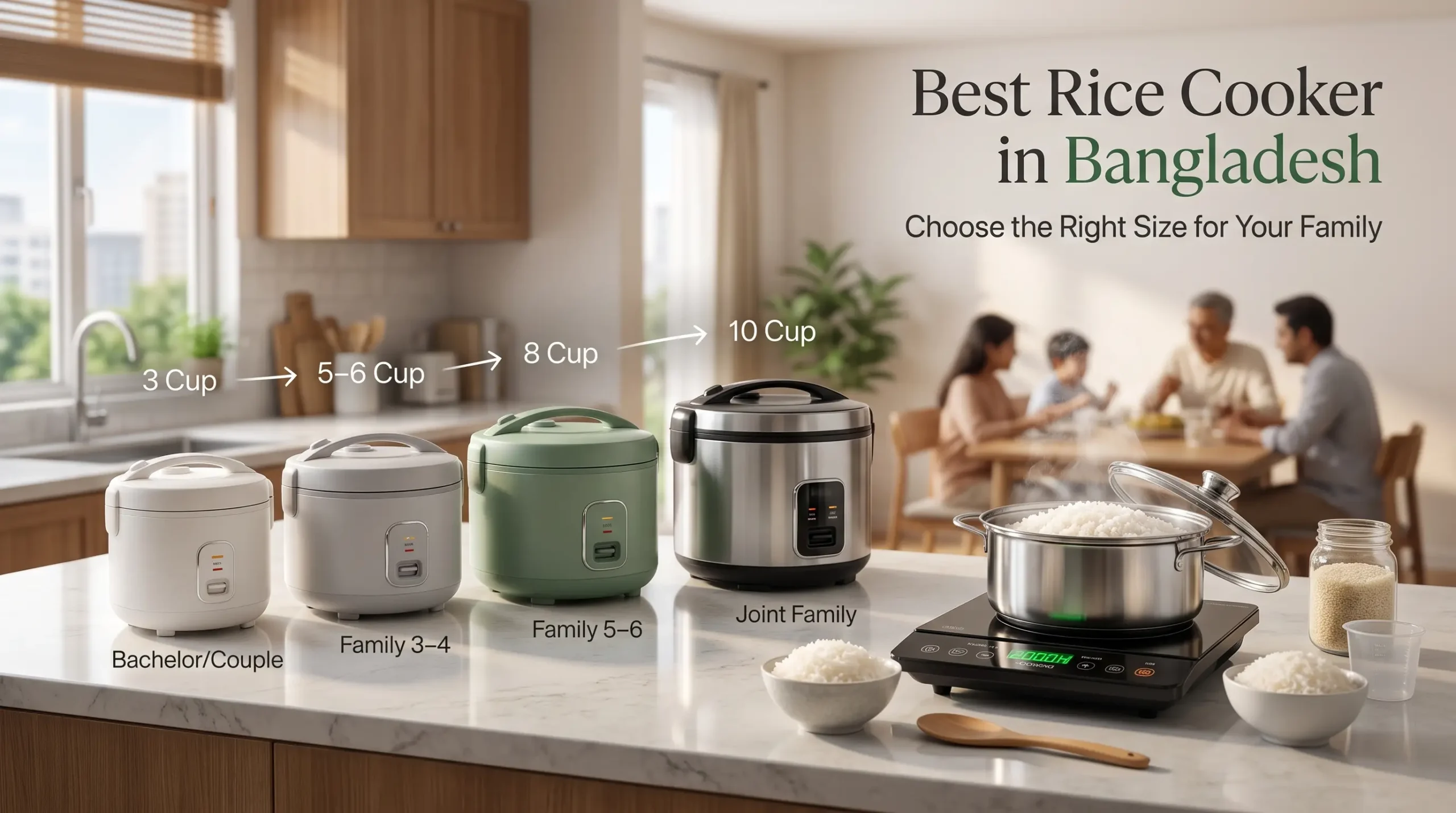
Best Rice Cooker in Bangladesh – Size Guide for BD Family Sizes

Smart Kitchen Gadgets Bangladesh · Supporting Article
How many cups your household actually needs before you spend a single taka
We checked our own shelves first, checked what’s genuinely sold in Bangladesh, and worked out the honest answer for joint families, small flats, and everyone in between.
Quick Answer
For a Bangladeshi household, buy rice cooker capacity by uncooked cup count, not litres: a couple or bachelor needs a 3-cup (1.5L) model, a family of 3-4 needs 5-6 cups (2.8L), and a joint family of 5-8 needs a 10-cup (5L) model. Right now, Gadgeterians does not stock a dedicated rice cooker – we’d rather tell you that upfront than list one we haven’t tested. What we do carry and stand behind is the Intex Indo Bolt B and Kiam H-22 induction cookers, both of which cook rice perfectly in a standard stainless steel pot and double as your daily cooking backup during load-shedding.
Rice is not a side dish in a Bangladeshi kitchen – it is the meal. A household in Mirpur or Mohammadpur cooks rice two, sometimes three times a day, and getting the quantity wrong has real consequences: too little and someone goes without at dinner, too much and it sits in the fridge going hard by morning. Yet almost every “best rice cooker” guide written for Bangladesh is either lifted from an American or Indian blog talking about 6-cup capacities that assume a 3-person nuclear household, or it is a spec-sheet dump with no actual guidance on which size fits which family.
That gap matters more here than almost anywhere else. A joint family in Old Dhaka cooking for eight people twice a day has completely different needs from a university student in a Rajshahi mess room cooking half a cup at a time. Voltage stability, load-shedding, and the fact that many BD kitchens still measure rice by the “mug” rather than the millilitre all change what “the right size” actually means.
This guide is part of our Smart Kitchen Gadgets in Bangladesh 2026 pillar guide – see the full pillar for our complete take on air fryers, induction cookers, and kettles. Here, we focus on one specific, practical question: what rice cooker capacity actually matches your family size, and – because we believe in being straight with you – what to do given that Gadgeterians doesn’t currently stock a dedicated rice cooker.
Let’s get the sizing right first, then talk honestly about where to buy.
1. Why Rice Cooker Sizing Works Differently in Bangladesh
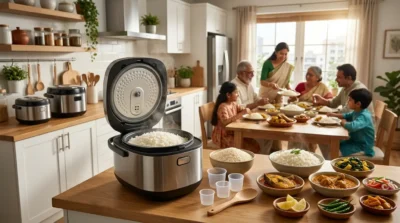
In most rice cooker marketing, “6 cups” means enough rice for a small Western family eating rice once or twice a week as a side. In Bangladesh, rice is the base of nearly every meal, and portion sizes per person tend to be larger – a working adult in Dhaka commonly eats 1.5 to 2 cups of cooked rice per meal, not the half-cup portion used in most international sizing charts.
Household structure adds another layer. Many BD homes are still multi-generational – parents, one or two married children, and grandchildren under one roof – which pushes daily rice volume well past what a “family of 4” chart assumes. Buying by generic capacity labels alone, without checking your own actual eating pattern, is the single most common rice cooker buying mistake in Bangladesh.
BD Tip: Most Bangladeshi households measure rice by the standard rice-cooker measuring cup (about 180ml, not a full 240ml cup), which yields roughly 1.5 cups of cooked rice. When comparing capacity between brands, always check whether the “cup” listed is the rice-cooker cup or a full metric cup – this single mix-up is why so many buyers end up with a cooker that’s too small.
2. How Rice Cooker Capacity Actually Works
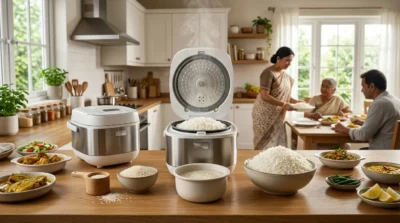
Rice roughly doubles to two-and-a-half times its volume once cooked, depending on the variety. A cooker rated “10 cups” is almost always describing raw, uncooked rice capacity – which then expands to somewhere between 20 and 25 cups of cooked rice once the water is absorbed. Manufacturers rarely make this distinction obvious on the box, which is exactly how people end up buying a cooker that looks huge in the shop but disappoints at home.
01
Rated in raw cups
A “6-cup” cooker means 6 cups of uncooked rice can fit, not 6 cups of finished rice on your plate.
02
Expands 2 to 2.5x
6 raw cups becomes roughly 13-15 cups of cooked rice once water is fully absorbed.
03
Never buy at max
Cooking at full rated capacity risks boil-over and uneven cooking. Buy one size above your daily need.
3. The BD Family Size Chart – What Capacity You Actually Need
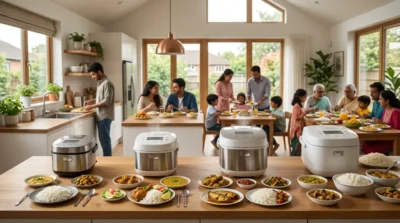
Use this as your starting point, then adjust up one tier if you regularly host guests, cook extra for iftar, or keep rice warm for staggered meal times (common when one family member works night shifts in Dhaka).
If your household falls between two tiers – say 4 to 5 people – round up rather than down. A slightly oversized cooker just means shorter cooking cycles at partial fill; an undersized one means cooking rice twice a day in two separate batches, which defeats the entire point of owning one.
4. Being Upfront: We Don’t Stock a Dedicated Rice Cooker Yet
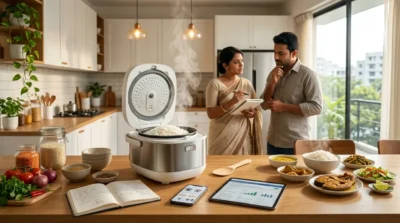
Here’s the honest part. As of this article, Gadgeterians does not carry a dedicated rice cooker in our Kitchen Gadgets collection. We could have written this article around a product we don’t actually sell and hoped nobody checked – but that’s exactly the kind of copy-pasted, misleading content we built Gadgeterians to be the alternative to.
The dedicated rice cooker market in Bangladesh is dominated by a handful of familiar names – Panasonic, Miyako, National, Walton, and Kiam all sell 1.5L to 2.8L models at various electronics retailers and marketplaces around the country, typically in the ৳2,000 to ৳6,000 range for a mid-range non-stick model with a keep-warm function. If a dedicated single-purpose rice cooker is a non-negotiable for your kitchen, those are the brand names worth researching directly with the retailer before you buy, and the sizing chart above still applies regardless of which brand you choose.
Important Reminder
We would rather send you elsewhere for a product we haven’t personally tested than list something in our shop just to capture a sale. What we can offer instead is a genuinely useful alternative that we do stock, verify, and stand behind – covered in the next section.
5. The Verified Alternative: Cooking Rice on an Induction Cooker
An induction cooker with a decent stainless steel pot cooks rice just as well as a dedicated rice cooker – arguably better, because you control the heat directly instead of trusting a single automatic sensor. It’s also a far more versatile appliance for a BD kitchen, since the same unit handles bhuna, dal, and tea on top of rice. Gadgeterians currently stocks two verified, in-stock induction cookers that work well for this:
Intex Indo Bolt B – 2000W
৳4,275 · Best For Small–Medium Families
7 preset cooking modes make it simple to switch from a rice setting to a stir-fry setting without guessing heat levels. Rapid heating means a 3–4 cup batch of rice is done in roughly the same time as a dedicated cooker.
Kiam H-22 – 2000W
৳4,500 · Best For Everyday Multi-Use Cooking
Crystal glass surface and multiple heat settings, with the same reliable 2000W output. Good pick if you want one appliance covering rice, curry, and tea on a single counter footprint.
To cook rice on either model: use a magnetic-base stainless steel pot (test with a fridge magnet – it must stick firmly), add rice and water at your usual 1:1.5 to 1:2 ratio, bring to a boil on the higher setting, then drop to the lowest simmer setting and cover for 12–15 minutes. Turn off and let it rest, covered, for 5 minutes before opening – this last step matters more on induction than in a dedicated cooker, since there’s no automatic “keep warm” switch to catch a slightly early shut-off.
BD Tip: Neither the Intex nor the Kiam works with aluminium pots or traditional Bangladeshi haari – only magnetic stainless steel or cast iron. If your current pots don’t stick to a magnet, factor in one induction-ready pot (widely available in Dhaka’s New Market and Chawkbazar kitchenware shops) alongside your cooker purchase.
6. Dedicated Rice Cooker vs Induction Cooker – Which Actually Suits You?
Neither option is universally “better” – it depends on how hands-off you want the process to be, and whether you want a single-purpose gadget or a multi-purpose one.
Induction Cooker + Pot
What We Stock and Verify
Multi-purpose – cooks rice, curry, and tea. Requires you to watch the pot and switch heat manually. No automatic keep-warm. Best if you already cook on gas and want an electric backup that does more than one job.
Dedicated Rice Cooker
Not Currently Stocked by Us
Single-purpose – rice only, but fully automatic with built-in keep-warm. Best if rice is the one thing you want to stop thinking about entirely, and you have separate counter space for a dedicated appliance.
7. What to Check Before Buying a Rice Cooker Anywhere in Bangladesh
If you do go ahead and buy a dedicated rice cooker from another retailer, these checks matter more in Bangladesh’s conditions than in a generic international buying guide.
Checklist Before You Buy
- Keep-warm wattage – Should be under 60W. A high-wattage keep-warm function left running all day quietly adds to your electricity bill and can dry out the rice.
- Non-stick coating thickness – Thin coatings peel within a year under Bangladesh’s typical daily-use pattern. Ask specifically about coating warranty, not just the overall product warranty.
- Voltage tolerance – Confirm 220–240V compatibility and check if the model has any built-in surge protection, since voltage spikes during load-shedding recovery are a common cause of appliance failure here.
- Local service centre – Brands with an actual Dhaka-based service centre (not just a Facebook page) save you from a dead cooker sitting unused for months.
- Steamer tray inclusion – Useful for reheating leftover curry or steaming vegetables alongside the rice, a common trick in space-limited kitchens.
These checks apply regardless of brand or where you buy – treat them as non-negotiable, not nice-to-haves.
8. Skip These: Facebook Live and Daraz Rice Cooker Red Flags
Rice cookers are one of the most commonly misrepresented appliances on Facebook live-sell pages and unverified Daraz.com.bd listings in Bangladesh. Here’s what to watch for.
9. Ramadan, Guests, and Load-Shedding – Planning Around the Edge Cases
Two situations push rice-cooking demand well above your normal daily pattern, and it’s worth planning for both before you buy.
During Ramadan, sehri and iftar often mean cooking rice for a larger group than your regular household size, especially if extended family joins for iftar. If this happens more than a few times a month in your home, size up one tier from the family chart above rather than buying twice as often for guests. And because rice cookers and induction cookers both need mains electricity, they stop working the moment load-shedding hits – exactly when a joint family might be trying to get sehri ready before fajr. A gas burner or a portable induction cooker with a small power bank backup (for lighting, not the cooker itself) is worth keeping as a fallback during Ramadan specifically.
BD Tip: If your area has predictable load-shedding windows, cook rice just before the scheduled outage rather than during it. Both dedicated rice cookers and induction cookers lose all progress the instant power cuts, and restarting a half-cooked pot rarely gives good results.
10. FAQs – Rice Cooker Sizing in Bangladesh
Tested In BD Conditions · No Fake Specs · Real After-Sales Support
Shop Kitchen Gadgets at Gadgeterians – Honest Picks Only
We test every appliance before it goes on sale and tell you plainly when something isn’t in our lineup yet. Right now that includes two verified induction cookers that cook rice reliably, plus air fryers, infrared cookers, and prep tools for every BD kitchen size.
Written by
Gadgeterians Team
For this guide, we checked our own current stock against what BD households actually need, tested rice cooking on our in-stock induction cookers with standard stainless steel pots, and cross-checked capacity ratings against real Bangladeshi portion sizes rather than international cup charts. Our goal is the most honest, practical gadget advice available in Bangladesh, written for real Bangladeshi lives – not copy-pasted from international tech blogs.
Induction Cooker
Kitchen Gadgets BD
Family Buying Guide
Load-Shedding Cooking