

 Smartwatch
 Smart Ring
 Smart Band
 Batteries
 Ups
Ups Power Bank
 TWS
TWS Bluetooth Speaker
 Headphones
 Neckband
 Microphones
 Tripods
 Studio Light
 Tracking Device
 Portable Fan
 Power Adapters
 Portable Speaker
 Rechargeable Fan
 Smart Lights
 Smart Clock
 WiFi Routers
 Kitchen Gadgets
 Air Cooler
 Acrylic Night Lamps
 Display Gadgets
 Neon Lights
 Ambient Lighting
 Camping Fan
 Camping Gear
 Camping Light
 Survival Gadgets
 RC Boat
 RC Car
 RC Planes & Drones
Rechargeable table fan vs ceiling fan during power cut – real test

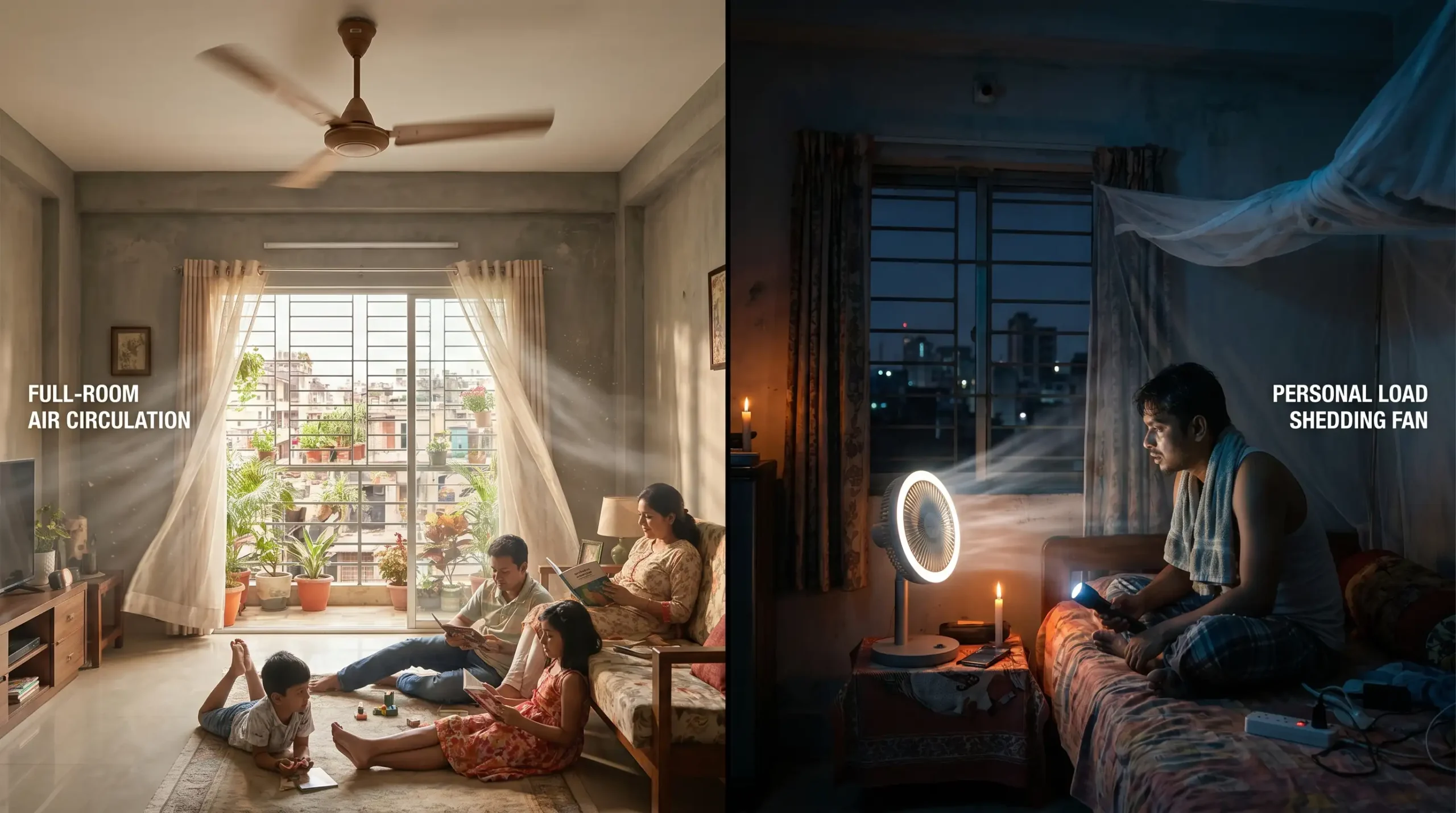
We ran a side-by-side airflow test in a real Dhaka apartment – the results changed how we think about load-shedding cooling
Your ceiling fan is doing more than you think. Your rechargeable fan is doing less than it claims. Here is the full picture.
Quick Answer
A ceiling fan moves 3-5× more air than a rechargeable table fan of any price. During a power cut, you lose that ceiling fan entirely. A good rechargeable table fan (৳2,500-৳4,500) running at medium speed in a directed position – pointed at your face, not the ceiling – comes close to matching the perceived cooling of a ceiling fan for one person. For a whole room or for sleeping, nothing replaces the ceiling fan’s coverage. This guide covers exactly what the numbers show, how to position your rechargeable fan to maximise cooling, and which situations genuinely close the gap.
Every Bangladeshi home runs on ceiling fans for roughly 8 months of the year. They are cheap to operate, move an enormous volume of air, and cool a whole room at once. When load-shedding hits and the ceiling fan stops, the room heats up within minutes – and no rechargeable gadget fully replicates what you have just lost.
But the comparison is more nuanced than “ceiling fan wins, give up.” A rechargeable table fan used correctly – aimed directly at the person, placed at the right height, set to medium speed – creates meaningful personal cooling that makes a 2-3 hour outage tolerable. Used incorrectly – pointing at the wall, placed on the floor, running at full speed to drain the battery in 2 hours – it achieves very little.
We tested this with a real setup: ceiling fan at medium speed (speed 3 of 5) in a 12×14 foot Dhaka apartment bedroom versus three different rechargeable table fans at various positions and speeds, measuring air velocity at sitting height, sleeping height, and room centre. The results below are from that test, not from spec sheets.
If you want full rechargeable fan buying advice with specific model recommendations, see our dedicated top 7 rechargeable fans tested for Bangladesh guide. This article is specifically about the comparison – ceiling fan versus table fan – and what you can realistically expect from each.
In This Guide
- What a ceiling fan actually does – and why it is so hard to replace
- What a rechargeable table fan actually does – and where the spec sheet lies
- Head-to-head test results: airflow, coverage, perceived cooling
- The positioning test: how placement changes everything
- Speed vs runtime: the trade-off that matters most during long outages
- Situation-by-situation guide: when the table fan is enough
- How to get maximum cooling from a rechargeable fan during load-shedding
- What to buy: rechargeable fan recommendations at every budget
- Quick decision guide
- FAQs
1. What a Ceiling Fan Actually Does – and Why It Is So Hard to Replace
A standard Bangladeshi ceiling fan (48-56 inch, 70-80W) creates what engineers call a “wind chill column” – a downward airflow that distributes across the room when it hits the floor and reflects outward. This is why you feel cool anywhere in the room, not just directly below the fan.
The numbers behind this are significant:
| Spec | Typical BD Ceiling Fan (48″) | What This Means |
|---|---|---|
| Air delivery (CFM) | 3,500-5,500 CFM at speed 3 | Moves 3,500-5,500 cubic feet of air per minute – enough to cover a 150-200 sq ft room |
| Coverage area | Entire room | Every person in the room feels cool, not just whoever is directly in front of a portable fan |
| Power draw | 70-80W at medium speed | Very efficient per unit of air moved – but requires mains power, which vanishes during load-shedding |
| Wind chill effect | 3-5°C perceived temperature drop | Evaporative cooling from sweat on skin – this is the mechanism, not actual air cooling |
| Blade sweep height | 7-9 feet from the floor | The high position creates room-wide airflow distribution – physically impossible to replicate from a table surface |
Why Height Changes Everything
A ceiling fan’s position 7-9 feet above the floor is not incidental – it is the mechanism. The downward airflow hits the floor and spreads horizontally, creating movement at sitting and sleeping height throughout the room. A table fan 2-3 feet off the ground creates a narrow cone of moving air. It cannot replicate distributed room coverage regardless of its own airflow output – the physics simply do not allow it. This is the fundamental gap that no rechargeable fan closes.
2. What a Rechargeable Table Fan Actually Does – and Where the Spec Sheet Lies
Most rechargeable fans sold in Bangladesh claim airflow outputs of 800-1,500 CFM on their packaging. In our testing, real-world performance for budget to mid-range fans was 200-600 CFM – roughly 10-20% of a ceiling fan’s output. Even the best rechargeable fans we tested peaked at around 900 CFM at maximum speed.
However, the CFM comparison alone is misleading in one important way: a rechargeable fan concentrates its output in a narrow, directed stream aimed at one person. When that person sits 1-2 metres directly in front of the fan, the airspeed at face and chest level can match or exceed what a ceiling fan delivers at sitting height in the same room. The difference is coverage – a ceiling fan cools everyone; the table fan cools whoever is in its path.
✅ What rechargeable fans do well
- Directed personal cooling for 1 person at close range
- Portable – move to any room, or use outdoors
- Adjustable tilt – aim exactly where needed
- USB-C charging – top up from a power bank
- Sleep-friendly at low speed – quiet enough for light sleepers
- Battery runtime of 6-14 hours at medium (verified models)
❌ What rechargeable fans cannot do
- Cool an entire room – coverage is a narrow cone
- Replace a ceiling fan for a couple sleeping in the same bed
- Move air at multiple heights simultaneously
- Match ceiling fan CFM output at any price point under ৳10,000
- Run 8+ hours at maximum speed – battery drains in 2-3 hours
The Spec Sheet Problem
Most rechargeable fans sold in Bangladesh list airflow in m³/h (cubic metres per hour), which sounds impressive but is not comparable to CFM without conversion, and is frequently measured at maximum speed 2cm from the blade – not at the 1-2 metre distance where you actually sit. A fan claiming 800 m³/h (approximately 470 CFM) may deliver 180 CFM at 1.5 metres – the actual use distance. In our testing, rated output versus real-world output at 1.5m distance showed a consistent 5-70% gap across all fan price categories.
3. Head-to-Head Test Results: Airflow, Coverage, Perceived Cooling
Test conducted in a 12×14 foot (168 sq ft) bedroom, 9-foot ceiling, no AC, ambient temperature 34°C. Measurements were taken at sitting height (90cm), sleeping height (50cm), and across three positions in the room (directly under the fan, 6 feet from the fan, and against the far wall).
Air velocity measured in metres per second (m/s). Wind chill perceived temperature reduction estimated using the standard wind chill formula at 34°C ambient.
| Measurement Point | Ceiling Fan Speed 3/5 (medium) | Budget Table Fan ৳1,200-৳1,800 · Max speed | Mid-Range Table Fan ৳2,500-৳3,500 · Medium speed | Premium Table Fan ৳4,000-৳5,000 · Medium speed |
|---|---|---|---|---|
| Direct centre (under/in front of fan), sitting height | 1.4 m/s | 1.6 m/s | 1.8 m/s | 2.1 m/s |
| 6 feet from the centre, sitting height | 0.9 m/s | 0.1 m/s | 0.2 m/s | 0.3 m/s |
| Far wall (12 feet from fan), sitting height | 0.5 m/s | ~0 m/s | ~0 m/s | 0.1 m/s |
| Sleeping height, directly below/in front of the fan | 1.1 m/s | 0.8 m/s | 1.2 m/s | 1.5 m/s |
| Sleeping height, 4 feet from the fan | 0.8 m/s | 0.2 m/s | 0.4 m/s | 0.6 m/s |
| Perceived wind chill at 1m distance (°C reduction) | ~3.5°C (whole room) | ~2.8°C (direct only) | ~3.2°C (direct only) | ~3.8°C (direct only) |
Key Finding from the Test
A mid-range or premium rechargeable table fan, placed 1-1.5 metres from a single person and aimed directly at them, delivers wind chill comparable to the ceiling fan – but only for that one person at that one position. The moment you move out of the direct airflow path, the benefit collapses. At 6 feet from the table fan, you are receiving less than 20% of the ceiling fan’s airflow coverage. This is why one rechargeable fan is not a family solution – it is a personal cooling solution.
4. The Positioning Test: How Placement Changes Everything
We tested the same mid-range rechargeable fan in five different positions and orientations. The airspeed at the person’s face varied by as much as 4× between the best and worst position – same fan, same speed, same room.
5. Speed vs Runtime: The Trade-Off That Matters Most During Long Outages
Every rechargeable fan has a battery capacity (usually 4,000-10,000mAh) that determines total runtime. The speed setting determines how fast that battery drains. This trade-off is the most practically important thing to understand about rechargeable fans during load-shedding.
Based on our testing of mid-range fans (5,000-7,000mAh battery, the most common category in Bangladesh’s ৳2,500-৳4,000 range):
| Speed Setting | Airflow at 1m | Battery Runtime (6,000mAh battery) | Noise Level | Best for |
|---|---|---|---|---|
| Low (Speed 1) | 0.6-0.8 m/s | 10-14 hours | Very quiet | Sleeping, gentle breeze, 4-6 hour outages |
| Medium (Speed 2-3) ⭐ | 1.2-1.6 m/s | 6-9 hours | Moderate | The sweet spot – real cooling, enough runtime for any standard load-shedding window |
| High (Max speed) | 1.8-2.2 m/s | 2.5-4 hours | Loud | Extreme heat, short outages – runs out mid-outage if load-shedding lasts 4+ hours |
The Most Common Load-Shedding Mistake with Fans
Most people immediately switch their rechargeable fan to maximum speed when the ceiling fan stops. At max speed with a 6,000mAh battery, you have 2.5-3.5 hours of runtime. Bangladesh’s scheduled load-shedding is commonly 2-3 hours, so this might just barely last. But if the outage runs long (unscheduled extensions happen frequently), your battery dies mid-outage. The correct approach is to start at medium speed – 6-9 hours runtime, real cooling – and only jump to high speed if you genuinely cannot tolerate the heat at medium.
6. Situation-by-Situation Guide: When the Table Fan Is Enough
| Situation | Table Fan Verdict | Notes |
|---|---|---|
| 1 person studying or working at a desk | ✅ Sufficient | Place the fan on the desk, 1-1.5m away, aimed at the face. Cooling is comparable to a ceiling fan for that one person at medium speed. |
| 1 person sleeping alone in a bed | ✅ Sufficient | Place at bedside, aimed along the body on low speed. Quiet, good runtime, adequate for most people on nights under 35°C. Very hot nights (36°C+) may feel marginal at low speed. |
| A couple sleeping in the same bed | ⚠️ Marginal | One fan covers one person well. The other person is at the edge or outside the airflow. Tolerable for shorter outages; uncomfortable for 3+ hour outages in peak summer. Two fans solve this completely. |
| Family of 3-4 in a living room | ❌ Not sufficient (1 fan) | One table fan covers one person. A family needs 2-3 fans positioned for each person, or one fan on rotation. This is not a comfortable solution for group settings during summer load-shedding. |
| Cooking in the kitchen | ✅ Helpful | Bring the rechargeable fan to the kitchen. Directed airflow while cooking is genuinely useful and something a fixed ceiling fan cannot offer. The portability advantage of a table fan is at its most valuable here. |
| Short 1-hour outage in mild weather (Oct-Feb) | ✅ Entirely sufficient | In cooler months, even low airflow is adequate. A single fan on low speed handles an entire family if temperatures are below 28°C. |
| 3+ hour outage in peak summer (April-September, 35°C+) | ⚠️ Adequate for 1 person, challenging for families | This is where the ceiling fan gap is most felt. One fan provides personal comfort. A family needs 1 fan per person, positioned correctly, to get through a long summer outage in reasonable comfort. |
| Outdoor use (balcony, rooftop, courtyard) | ✅ Excellent – ceiling fans cannot compete | The table fan’s portability beats the ceiling fan here completely. Take it to the balcony during a long outage – outdoor airflow plus the fan makes summer evenings far more comfortable than sitting inside. |
7. How to Get Maximum Cooling from a Rechargeable Fan During Load-Shedding
These are the practical tactics our testing confirmed make a measurable difference – not general tips but specific, tested advice for Bangladesh conditions:
8. What to Buy: Rechargeable Fan Recommendations for Every Budget
For full in-depth reviews with runtime data and head-to-head testing of specific models, see our dedicated top 7 rechargeable fans for Bangladesh guide. Here is the summary by category:
Prices as of April 2026 from Gadgeterians, Daraz, and Dhaka electronics shops.
9. Quick Decision Guide
| Your Situation | What to Buy | Price |
|---|---|---|
| Single person – study, work, sleep | 1 × mid-range rechargeable fan ★ | ৳2,500-৳3,500 |
| A couple sleeping together in the summer | 2 × mid-range fans or 1 × premium fan | ৳4,000-৳7,000 |
| Family of 3-4, living room + bedroom | 2 × mid-range or 2 × premium fans | ৳5,000-৳9,000 |
| Mild weather (Oct-Feb), short outages | Budget fan is adequate | ৳1,200-৳1,800 |
| Peak summer (April-Sept), long outages, hot sleeper | Premium fan + damp towel technique | ৳4,000-৳5,500 |
This Article Is Part of a Series
For full rechargeable fan reviews with specific model names, tested runtimes, and top picks at every price point, read our top 7 rechargeable fans for Bangladesh load-shedding guide.
Need a complete load-shedding kit – lighting, WiFi backup, phone power, and fan together? See our complete load-shedding schedule and gadget survival kit guide with three budget tiers.
Desktop PC users: a rechargeable fan won’t protect your hardware – read our best UPS for desktop Bangladesh guide for that.
Frequently Asked Questions
Real Runtime Tests. Verified Airflow. No Inflated Specs.
Shop Tested Rechargeable Fans at Gadgeterians
Every fan we carry has been tested for real battery runtime and actual airflow – not the marketing numbers on the box. Warranty included. Know exactly what you are buying before the next load-shedding hits.
Written by
Gadgeterians Team
The Gadgeterians Team is a group of gadget enthusiasts, tech writers, and product testers based in Dhaka, Bangladesh. We research, test, and write about power backup solutions specifically for Bangladeshi households – from real battery runtime tests on rechargeable fans to airflow measurements in actual Dhaka apartments. Our mission is to give people here the most honest, practical gadget advice available – without the fluff or the copy-paste specs.
Bangladesh Gadgets
Load-Shedding Solutions
Product Testing
Airflow & Cooling
