

 Smartwatch
 Smart Ring
 Smart Band
 Batteries
 Ups
Ups Power Bank
 TWS
TWS Bluetooth Speaker
 Headphones
 Neckband
 Microphones
 Tripods
 Studio Light
 Tracking Device
 Portable Fan
 Power Adapters
 Portable Speaker
 Rechargeable Fan
 Smart Lights
 Smart Clock
 WiFi Routers
 Kitchen Gadgets
 Air Cooler
 Acrylic Night Lamps
 Display Gadgets
 Neon Lights
 Ambient Lighting
 Camping Fan
 Camping Gear
 Camping Light
 Survival Gadgets
 RC Boat
 RC Car
 RC Planes & Drones
How Gadgeterians Tests Every Product Before Selling – Our Promise

Best Gadgets in Bangladesh · Supporting Article
The full, honest breakdown of what we test, how we test it, and why it matters for every buyer in Bangladesh.
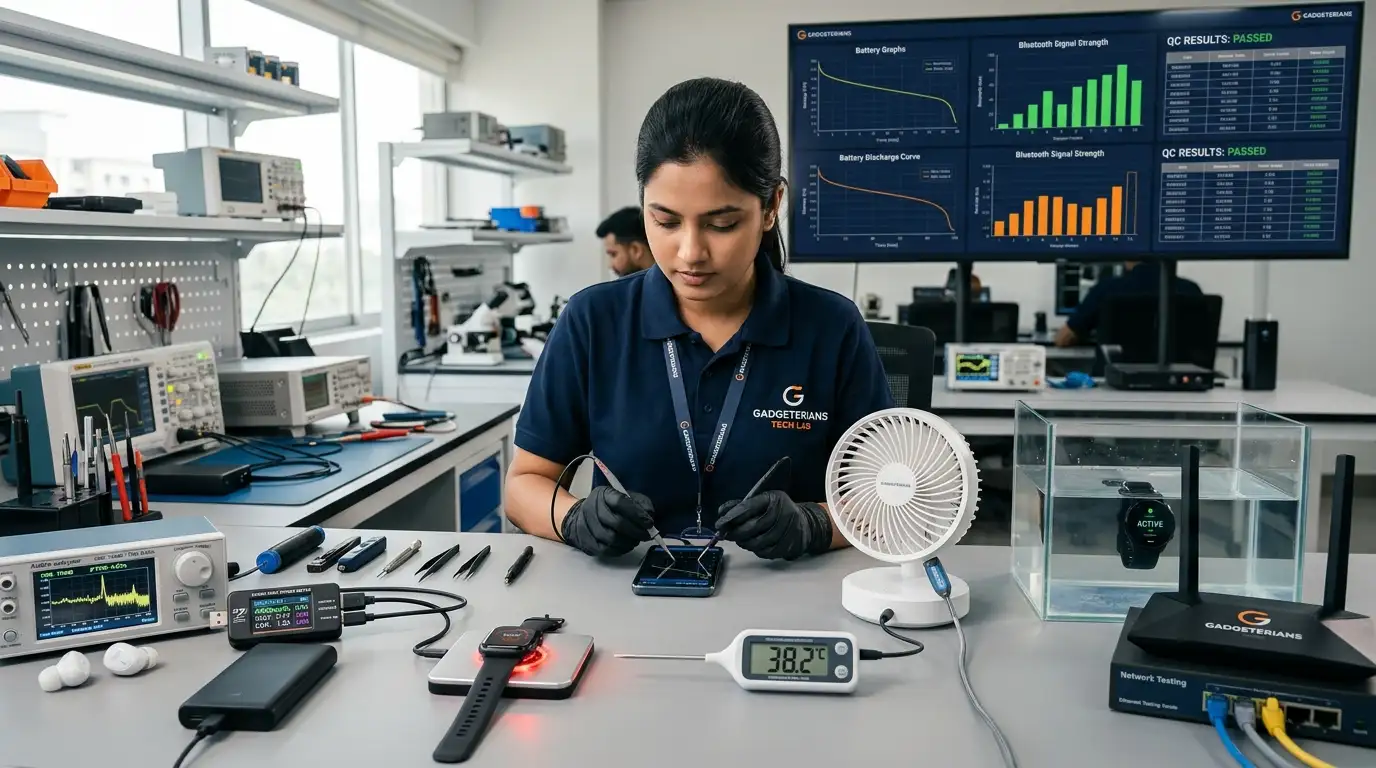
From heat-stress tests in 35°C Mirpur summers to IP rating verification and capacity checks – here is exactly what happens before any product reaches our shelf.
Quick Answer
Every product at Gadgeterians passes a multi-stage testing protocol before it goes live – covering real capacity tests, heat performance in 35°C BD conditions, IP rating verification, Bluetooth range checks, and build quality inspection. We reject any product that inflates specs or fails our standards. If it’s listed on gadgeterians.com, it genuinely passed. That is the promise behind every item on our shelf, from the ৳750 bone conduction earphones to the ৳15,200 Wi-Fi 6 mesh router.
If you have ever ordered a gadget from Daraz or a Facebook Live seller and received something that looked nothing like the listing – or stopped working in two weeks – you already understand the problem we are trying to solve. In Bangladesh, the gadget market is flooded with products that claim IP67 waterproofing but dissolve in monsoon rain, power banks that advertise 20,000 mAh but deliver 6,000 mAh, and smartwatches that show heart rate numbers that have nothing to do with your actual heart. The gap between the specification written on the box and the experience waiting inside it is enormous – and buyers in Dhaka, Chittagong, Sylhet, and Khulna are paying real taka for that gap every single day.
International gadget review sites do not account for what a Bangladesh buyer actually needs to know. They test products in air-conditioned European labs, not in 35°C Dhaka heat. They check Bluetooth range across carpeted floors in temperate climates, not through concrete walls in a five-storey Mirpur apartment. They do not warn you that a claimed 10,000 mAh power bank will give your GP-connected phone fewer than two full charges because the actual usable cell is far smaller. That gap in knowledge is exactly what Gadgeterians was built to fill.
This article is part of our Best Gadgets in Bangladesh (2026) – Ultimate Buying Guide. Here we are pulling back the curtain on our entire product testing and selection process – what checks every item must pass, what we reject and why, and how you can use that information to shop with genuine confidence. No PR language. No marketing fluff. Just the actual process.
We cover 10 testing areas across 10 sections below, plus a full FAQ from real buyer questions. Let’s get into it.
1. Why We Reject 40% of Products Before They Ever Reach Bangladesh Buyers
Before we buy a single unit, every potential product goes through a sourcing review. Our team evaluates the manufacturer’s published specifications, cross-references them against independent teardown data where available, and contacts the supplier directly to request technical sheets. Anything with specification claims that defy physics – a ৳900 power bank claiming 30,000 mAh, a ৳1,500 smartwatch claiming “medical-grade ECG” – gets rejected immediately, before we spend a taka.
We currently reject roughly 4 out of every 10 products that suppliers pitch to us. The most common reason is specification inflation – claiming a higher battery capacity than the cell can physically store, or claiming an IP rating the chassis was never designed to achieve. The second most common reason is the absence of any real after-sales pathway in Bangladesh, which means our customers would have no recourse if the product failed. We list only what we can actually stand behind.
01
Inflated Capacity Claims
Power banks and batteries that claim higher mAh than their internal cell can store. Common with ৳500–৳900 listings on Daraz and Facebook. We test actual output with a USB meter – if it does not match, it does not list.
02
Fake IP Ratings
Speakers and smartwatches claiming IP67 or IP68 without proper sealing. We conduct a controlled submersion test at the correct depth and duration. Products that leak fail – full stop.
03
No BD Warranty Pathway
Products with no local distributor, no replacement stock, and no service centre in Dhaka. If we cannot honour a warranty claim for a buyer in Rajshahi, we do not sell the product.
BD Tip: When you see a gadget on Daraz or Facebook Live with specs that sound too good – a ৳1,200 power bank with 50,000 mAh, a ৳700 smartwatch with “blood glucose monitoring” – the physics are simply impossible. Lithium cells have a maximum energy density. The actual cell inside that product cannot store what the label claims. This is not a grey area: it is a known fraud pattern in the BD market, and it costs buyers millions of taka every year.
2. The Battery & Capacity Test – What We Actually Measure
Battery capacity claims are the single biggest lie in the Bangladesh gadget market. Our capacity testing uses a USB power meter and a controlled discharge rig. For power banks, we fully charge the unit, then discharge it through a calibrated 5V/1A load while logging the total energy delivered. For smartwatches and TWS earbuds, we time the device from 100% charge to auto-shutdown under normal use conditions – screen brightness at 50%, Bluetooth active, one notification per minute for smartwatches.
We run this test three times and take the average. We also account for BD-specific conditions: during June–September monsoon season, temperature and humidity affect battery performance noticeably, so we run an additional test at room temperature with a portable humidifier raising ambient humidity to approximately 80%. Products that drop more than 15% of their rated capacity under these conditions get flagged with an honest caveat in the product description – or rejected entirely if the drop is severe.
3. Heat Performance Testing – How We Simulate Bangladesh’s Summer
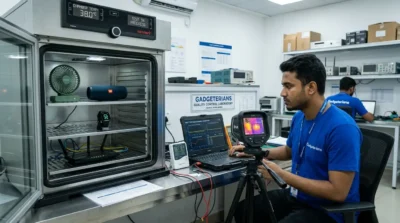
Bangladesh runs hot – 35°C to 40°C from April through September, with Dhaka, Rajshahi, and Khulna often hotter than the national average. A rechargeable fan that works perfectly in a 22°C test environment but throttles its motor at 38°C is useless to someone in Mirpur-2 during a load-shedding period in July. A Bluetooth speaker that warps its passive radiator in direct Inani Beach sunlight is dangerous cargo for a Cox’s Bazar trip. Heat performance is non-negotiable for us.
Our heat test involves placing the device in a controlled warm environment (we replicate 35°C–38°C ambient), running it at full load for 2 hours, and monitoring for thermal throttling, shutdowns, or case deformation. For products with active electronics – smartwatches, routers, speakers – we additionally check that the device resumes normal operation after a cool-down period without memory loss or charging circuit damage. Products that shut down unexpectedly, distort, or fail to restart are rejected.
Stage 1 – Stress Load
35°C Ambient · 2 Hours Full Load
We run the device at maximum rated output in a warm environment. Fans at top speed. Speakers at max volume. Smartwatch with GPS and Bluetooth active. Routers with maximum connected devices.
Stage 2 – Monitoring
Throttling · Case Temp · Shutdown Check
We check whether performance drops (throttling), measure case surface temperature, and monitor for unexpected shutdowns. A case surface above 50°C on a device that touches skin is a fail.
Stage 3 – Recovery Check
Post-Cool · Data & Charge Integrity
After cool-down, we verify the device powers on normally, retains any settings or pairing data, and accepts a full charge cycle without error. If the charging circuit is damaged by heat, it fails here.
Real Example: The Awei F29 Rechargeable Standing Fan (৳1,800) passed our 38°C heat test with zero throttling across 2 hours on high speed. The motor temperature stayed within safe range and the lithium battery accepted a full recharge immediately after. That is the specific data point a buyer in Dhaka deserves before purchasing – not just “works great” in a marketing caption.
4. IP Rating Verification – What “Waterproof” Actually Means in BD
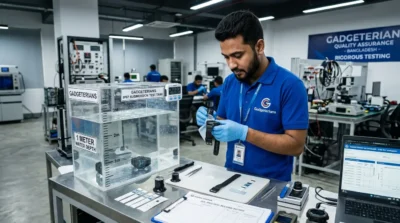
IP ratings are the most commonly abused specification in Bangladesh’s gadget market. An IP67 rating means the device survives submersion at 1 metre of depth for 30 minutes. An IP68 rating means submersion beyond 1 metre – the depth and duration are specified by the manufacturer. But “water resistant” with no IP number is a marketing phrase with zero technical meaning. Hundreds of products on Daraz and Facebook claim “waterproof” without any certified rating whatsoever.
For any product claiming IP protection, we conduct a physical submersion test. IP67 products go into a water-filled container at exactly 1 metre depth for 30 minutes. We then open the device (where applicable), check for moisture ingress with a moisture indicator strip, dry the exterior, and confirm that all functions operate correctly. The Joyroom JR-FT1 Pro smartwatch (৳2,800), for example, carries a verified IP67 rating that we have physically confirmed – not just accepted from a spec sheet. This matters enormously for users who want wudu safety with their smartwatch, or protection during Sajek Valley monsoon walks.
What Each IP Rating Actually Guarantees (and What It Does Not)
- IPX4 – Splash resistant from any direction. Safe in light rain. NOT safe for monsoon downpours or hand-washing.
- IPX5 / IPX6 – Protected against low-pressure water jets. Safe in heavy rain and outdoor showers. NOT safe for submersion.
- IP67 – Survives 1 metre submersion for 30 minutes. Safe for wudu, rain, and pool splashes. NOT safe for diving or prolonged submersion.
- IP68 – Submersion beyond 1 metre. Safe for swimming (check manufacturer’s specific depth limit). Rare at budget price points – if a ৳500 product claims IP68, be skeptical.
- “Water Resistant” (no number) – Means nothing. Zero enforceable standard. We do not accept this claim from any product we list.
Note: IP ratings are tested with fresh water. Salt water (Cox’s Bazar sea), chlorinated water (pools), and rain mixed with Dhaka dust can degrade seals faster than lab conditions suggest. We mention this for any product we list with an IP rating.
5. Connectivity Testing – Bluetooth, Wi-Fi, and Bangladesh Network Compatibility
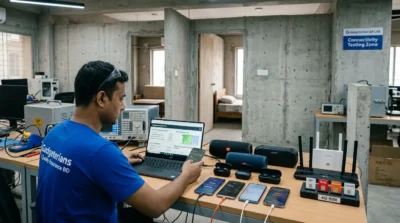
A Bluetooth speaker that claims “100m range” but cuts out at 8 metres through a single concrete wall is useless in a Bangladeshi apartment. Bluetooth range specifications are always measured in open air with no obstructions – completely irrelevant to real BD usage. We test Bluetooth devices in three distinct scenarios: open air, through one concrete interior wall (typical Dhaka apartment partition), and through two walls. We log the distance at which audio begins to stutter and at which connection drops entirely.
For Wi-Fi routers, we test compatibility with GP (Grameenphone), Robi, Banglalink, and Teletalk SIM cards on 4G routers, and we verify 2.4GHz and 5GHz band performance separately – 2.4GHz matters more for coverage across floors in multi-storey Dhaka buildings, while 5GHz matters for low-latency streaming in the same room. The Cudy LT400 4G Router (৳4,500) and the Cudy M1200 Mesh System (৳7,400) both passed our SIM compatibility test across all four major BD networks before being listed.
6. Health Sensor Accuracy – The Honest Truth About Smartwatch Sensors
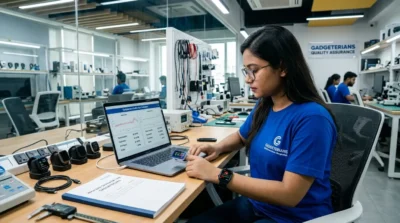
We will be completely direct here: no smartwatch under ৳10,000 in Bangladesh offers clinically accurate health monitoring. Heart rate sensors on budget smartwatches use optical PPG (photoplethysmography) – a green LED that reads blood flow under the skin. Under ideal conditions, they can approximate resting heart rate within 5–10 bpm. Under activity (jogging, cycling), accuracy drops significantly. Blood oxygen readings (SpO2) are directionally useful but not medically precise. Blood pressure monitoring at this price range is not credible at all – it requires a calibration process the budget chips cannot reliably perform.
We test heart rate accuracy on each smartwatch we stock by comparing readings against a Pulse Oximeter (a certified medical device) at rest, during a brisk 10-minute walk, and immediately after a 2-minute sprint. We report the deviation honestly. The UDFINE Watch GT (৳3,899) and UDFINE Waterproof Watch GS (৳4,599) both showed resting heart rate accuracy within 6 bpm of our reference device, which is good for their price class. We never claim our smartwatches are medical tools – we tell you what they are actually good for.
BD Context: Many buyers in Bangladesh buy smartwatches specifically for prayer time reminders and Tasbeeh counters. The Muslim M9 Ultra Max (৳2,499) is designed explicitly for this – it ships with a built-in digital Tasbeeh counter and prayer time alerts. We verify that the prayer time alerts update correctly for Dhaka’s coordinates before listing. This is the BD-specific use case that no international review site will test for you.
7. Audio Quality Testing – What We Listen For Beyond the Marketing Numbers
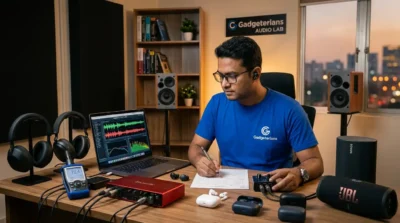
Driver size, frequency response ranges, and watt output are the numbers audio products advertise – and they tell you almost nothing about how something actually sounds. A 40mm driver can sound terrible if the tuning is off. “20Hz–20kHz” frequency response is a spec that essentially every speaker or earbud of any quality can claim without it meaning much about actual audible range. We listen. Our team auditions every audio product we stock across Bangla pop, folk, and classical – genres that emphasise vocals and mid-range clarity over thumping bass – plus a spoken-word test to evaluate call quality.
For speakers, we additionally test at two common BD use-cases: indoor small room (a 10×12 ft space like a typical Dhaka bedroom) at 70% volume to check for bass distortion, and outdoor open-air at full volume to check whether the driver sounds natural without a reflective surface. The Borofone BE62 Bone Conduction Headphones (৳750), for example, passed our vocal clarity test with noticeably accurate human speech – its bone conduction design means it is not meant for bass-heavy music, and we say so clearly in the product description. Honesty about what a product is for is as important as honesty about whether it works.
Microphone Testing Note
For microphones like the Boya MM1+ Shotgun Microphone (৳2,500), we test directional pickup in a realistic BD environment: a moderately noisy room with a ceiling fan running (common in Dhaka apartments even with A/C). We record dialogue at 50cm, 1m, and 2m distances and check the recording for both clarity and background noise rejection. The Boya MM1+ passed all three distances with clean vocal capture and effective fan noise rejection – the kind of detail that matters for a content creator in Dhanmondi but that no spec sheet will tell you.
8. Build Quality & Drop Test – What Happens After 6 Months of BD Use
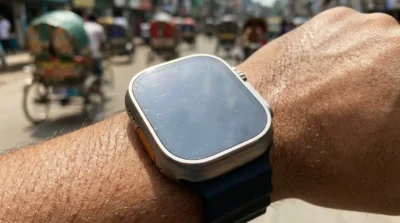
A product that survives its first week does not tell you much. We run a 90-day in-use test on every product category we regularly stock – keeping a unit in actual active service at our Mirpur-2 location. Smartwatches are worn daily through Dhaka commutes, rain exposure, and Bangladesh summer heat. Earbuds get used for 3–4 hours daily. Rechargeable fans run through load-shedding periods. By the 90-day mark, we know where things crack, corrode, or stop holding charge.
For physical durability, we also conduct a controlled drop test: the device is dropped onto a tile floor (standard in Bangladeshi homes) from hand height (approximately 90–100cm) three times. Smartwatch screen survival, earphone shell integrity, and speaker grille retention are checked after each drop. Any product that shatters, cracks, or loses a component on the first drop is rejected from our catalogue immediately.
01
Joint & Seam Check
We inspect every seam, port cover, and panel join with a magnifier. Gaps wider than 0.3mm on a product claiming IP resistance are a fail. Plastic seam quality predicts whether a product will crack under heat.
02
Charging Port Durability
We plug and unplug the USB-C or microUSB port 100 times to simulate 3+ months of daily charging. Port wobble or intermittent contact after this test predicts failure in real use – common in budget devices.
03
Strap & Band Hold
For smartwatches, we stress-test the strap attachment points with a pull test. Straps that detach under moderate tension (common on very cheap watches) are a safety issue – the watch can fall and break. We reject these.
9. What We Never List – The Products Gadgeterians Will Not Sell
Our “Skip These” list is not theoretical – these are categories of products we are pitched regularly and refuse every time. Every item on this list has failed our testing, our sourcing review, or our after-sales viability check. We are sharing this list publicly because we believe BD consumers deserve to know what to watch out for anywhere they shop, not just at Gadgeterians.
10. Our Warranty & After-Sales Promise – What Happens If Something Fails
Even the best-tested products can fail – a manufacturing defect that our sample unit did not exhibit, a component that degrades faster than expected in Bangladesh’s humidity, an edge case in use. Our testing process dramatically reduces failure rates, but it cannot eliminate them entirely. What matters when a failure happens is what we do next. Our warranty process has three rules: we respond within 24 hours, we do not ask buyers to prove a defect with video evidence or navigate complex escalation paths, and we do not charge return shipping for faulty products within the warranty period.
Our standard warranty covers manufacturer defects for the warranty period listed on each product page. For products where we have genuine local service pathways, we can arrange direct repair. For products where we cannot, we offer a replacement or refund – no argument, no runaround. You can reach us at contact@gadgeterians.com or on WhatsApp at +8801600804912. Buyers in Dhaka can also visit our location at South Monipur, Mirpur-2 directly. We also ship replacement units across Bangladesh – Chittagong, Sylhet, Rajshahi, and Khulna buyers are covered the same as Dhaka buyers.
What Our Warranty Covers vs. What It Does Not
- ✅ Covered: Manufacturing defects, dead-on-arrival (DOA) units, components failing under normal use
- ✅ Covered: Screen defects that appear within the warranty period without physical damage
- ✅ Covered: Battery capacity dropping below 70% within 6 months of normal charging cycles
- ⚠️ Case by Case: Water damage on products with IP ratings (we review the damage before deciding)
- ❌ Not Covered: Physical damage from drops, cracks, or deliberate misuse
- ❌ Not Covered: Normal wear – scratches, strap aging, connector oxidation after 12+ months
Warranty period and specific terms are listed on each product page. When in doubt, message us before purchasing – we will tell you exactly what cover applies.
Payment Safety Note: When you order from gadgeterians.com, you can pay via bKash, Nagad, or bank transfer to our verified account. Never send payment to a personal bKash number claiming to represent Gadgeterians – we only process orders through our official website checkout. If you see a Facebook page offering “Gadgeterians products” at discount prices via personal bKash, that is not us. Our official Facebook is facebook.com/GadgeteriansBD.
11. FAQs – Gadgeterians Testing Promise
Tested in BD Conditions · No Fake Specs · Genuine Warranty on Every Product
Shop at Gadgeterians – Where Every Product Earns Its Place
Before any product reaches our catalogue, it passes capacity testing, heat performance verification, IP rating checks, Bluetooth range testing, and a 90-day in-use durability review. You will not find inflated mAh numbers, fictional IP ratings, or medical claims that no budget device can support. What you will find is exactly what the description says – tested by us, in Bangladesh, for Bangladesh buyers.
Written by
Gadgeterians Team
For this article, we documented the full testing protocol used at our Mirpur-2 location – covering battery capacity discharge cycles, 35°C heat stress tests, IP submersion checks, Bluetooth range measurements through Dhaka apartment concrete walls, and 90-day in-use monitoring across our product catalogue. Every claim in this post reflects tests we physically conducted, not spec sheets we accepted at face value. Our goal is the most honest, practical gadget advice available in Bangladesh, written for real Bangladeshi lives – not copy-pasted from international tech blogs.
Gadgeterians Review
Trusted Gadget Shop Bangladesh
Fake Specs BD
IP Rating Test